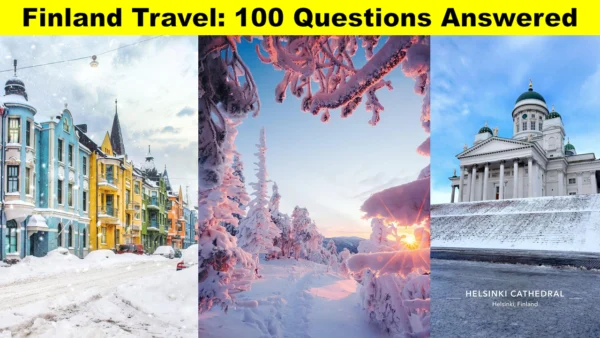
Finland Travel: 100 Questions Answered based on NeemTime research
📅 Planning, Timing & Northern Lights
1. When is the best time to see the Northern Lights?
The Aurora Borealis is visible from late September to March. The key is dark, clear skies. Statistically, the equinoxes in September/October and March often have high solar activity.
2. Can I see the Northern Lights in Helsinki?
It is rare due to light pollution and its southern location. You need to head north to Finnish Lapland (cities like Rovaniemi, Ivalo, or Levi) for a reliable chance.
3. What is the “Midnight Sun” and when does it happen?
In June and July, the sun does not set at all in the north, and even in the south, it only dips briefly below the horizon, leaving night-long twilight.
4. When does the first snow usually fall in Lapland?
Permanent snow cover typically arrives in Lapland by late November. If you want a guaranteed winter wonderland experience, aim for December through March.
5. Is November a good time to visit Finland?
Travelers consensus is that November can be dark, slushy, and gloomy in the south (Helsinki), while the north is only just starting to get snow. Many call it the most challenging month for tourism.
6. What is “Ruska” and when does it happen?
Ruska is the autumn foliage season when the landscapes turn vibrant shades of red, orange, and yellow. It hits Lapland in mid-September and moves south by early October.
7. Are things open during Midsummer (Juhannus)?
No. Midsummer (late June) is a major national holiday. Cities like Helsinki become ghost towns because locals head to summer cottages. Public transport operates on reduced schedules, and many shops close.
8. How many days do I need for a basic Finland trip?
Travelers recommend 3 to 4 days if you are just staying in Helsinki, but 7 to 10 days if you plan to combine the capital with a trip up to Lapland or the Lake District.
9. Is Christmas a good time to visit Rovaniemi?
It is magical but incredibly crowded and expensive. Booking 6 to 12 months in advance is highly recommended by travelers.
10. What is the weather like in summer?
Summer (June–August) is mild and pleasant. Temperatures usually hover around 15°C to 25°C. Heatwaves can occasionally push it past 30°C.
💰 Budget, Currency & Expenses
11. Is Finland expensive to visit?
Yes, it is a Nordic country, so prices for dining out, alcohol, and accommodation are higher than the European average, though generally slightly cheaper than Norway or Iceland.
12. What currency does Finland use?
Finland uses the Euro (€). It is the only Nordic country to do so.
13. Do I need cash in Finland?
Almost never. Finland is a highly cashless society. You can pay for everything—from a coffee to a taxi—with a credit/debit card or contactless payment.
14. Should I tip in restaurants?
Tipping is not part of Finnish culture. Service charges are included in the bill. If the service was exceptional, rounding up to the nearest 5 or 10 Euros is appreciated but never expected.
15. How much does a average meal cost?
A casual lunch (often a buffet style “lounas”) costs around 12 to 15 Euros. A mid-range dinner at a restaurant will cost about 30 to 50 Euros per person without drinks.
16. How can I save money on food?
Look for “Lounas” (lunch) signs on weekdays between 11:00 AM and 2:00 PM. Many restaurants offer all-you-can-eat soup, salad, and main course deals for a fraction of dinner prices. Supermarket meals (from K-Market or S-Market) are also great budget options.
17. Why is alcohol so expensive in Finland?
Finland taxes alcohol heavily. Furthermore, drinks above 8% ABV can only be purchased at the state-owned monopoly stores called Alko.
18. Are museum entry fees expensive?
They range from 10 to 20 Euros. If you plan to visit many museums in Helsinki, look into the Helsinki Card or buying a national Museum Card (Museokortti) if staying longer.
19. Is student discount widely accepted?
Yes, international student cards (ISIC) are widely accepted for trains, buses, and museum admissions.
20. Is tap water safe to drink?
It is not just safe; it is exceptionally clean, delicious, and often tastes better than bottled water. Never buy bottled water; just refill your flask from the tap.
🧳 Packing & Clothing
21. What should I pack for Lapland in the winter?
Layers are key. Bring thermal merino wool base layers, a fleece or wool mid-layer, and a wind- and waterproof heavy winter coat. Don’t forget insulated boots, thick wool socks, a beanie, and heavy gloves.
22. Can I rent winter clothing there?
Yes. If you book tours in Lapland (like safari packages), they almost always include heavy thermal overalls and boots. You can also rent winter clothing sets in Rovaniemi or Levi.
23. What kind of shoes do I need for winter?
You need waterproof, insulated boots with good traction rubber soles. For icy conditions, many travelers buy cheap slip-on ice spikes (liukuesteet) for their shoes at local supermarkets.
24. What should I pack for a Finnish summer?
Bring light clothing for warm days, but always pack a light jacket or sweater for cooler evenings, along with swimwear and a raincoat.
25. Do I need mosquito repellent?
If you are visiting Lapland or the Lake District in July, absolutely. The mosquitoes can be intense in the woods. Buy local repellent (like “Ohvo”) as it is formulated for Finnish insects.
26. Do I need to dress up for restaurants in Helsinki?
Finnish dress culture is casual and functional. Clean jeans and a nice sweater or shirt are perfectly acceptable even in high-end restaurants.
27. What adapter do I need for electronics?
Finland uses Type C and Type F plugs (standard European round two-prong plugs). The voltage is 230V.
28. How do I protect my phone battery in the extreme cold?
Sub-zero temperatures drain phone batteries rapidly. Keep your phone in an inside pocket close to your body heat, and carry a portable power bank.
29. Are sunglasses necessary in winter?
Yes, especially in February and March. The sun reflecting off the white snow can be incredibly blinding.
30. What should I wear to a traditional sauna?
In public saunas, you are usually expected to go naked (segregated by gender), but some mixed saunas require a swimsuit. Always bring a towel to sit on.
31. How do I get from Helsinki Airport to the city center?
The easiest and cheapest way is the commuter train (lines I and P). It takes about 30 minutes and costs around 4.10 Euros (ABC zone ticket).
32. What app should I use for public transport in Helsinki?
Download the HSL app. You can plan routes, check timetables, and buy your tickets directly on your phone.
33. Can I buy transport tickets from the driver?
No, you cannot buy tickets on board buses or trains in Helsinki. You must buy them via the app or at ticket machines before boarding.
34. How do I travel from Helsinki to Rovaniemi?
You can take a domestic flight (about 1.5 hours) or take the famous overnight “Santa Claus Express” train run by VR (about 10–12 hours).
35. Is the night train to Lapland comfortable?
Yes, booking a private sleeper cabin (especially the upstairs ones with an en-suite shower and toilet) is highly recommended by travelers for a comfortable, scenic journey.
36. Is it safe to drive in Finland during winter?
If you are not experienced with driving on ice and packed snow, it can be stressful. Finnish cars are equipped with studded or winter tires by law, but driving requires extreme caution, lower speeds, and watching out for wildlife like moose and reindeer.
37. How do I get from Helsinki to Tallinn (Estonia)?
There are frequent daily ferry services operated by Tallink Silja, Viking Line, and Eckerö Line. The journey takes about 2 hours across the Gulf of Finland.
38. Is ride-sharing available in Finland?
Yes, Uber and Bolt operate legally and widely in Helsinki, but they are scarce or non-existent in small towns and remote Lapland areas.
39. Are taxis expensive in Finland?
Yes, taxis are regulated but can be pricey. It is best to use apps like Taksi Helsinki or Menevä to see fixed prices beforehand to avoid surprises.
40. Can I travel around Finland easily by train?
The national railway company (VR) runs an excellent, punctual, and modern train network connecting major cities like Helsinki, Tampere, Turku, and Oulu.
🏡 Accommodation & Facilities
41. Is it worth staying in a glass igloo in Lapland?
They are very expensive (often 400–800 Euros a night). Most travelers recommend staying in one for just a single night for the experience, and using a standard cabin or hotel for the rest of your trip.
42. Do all Finnish homes and hotels have saunas?
An overwhelming majority do. Even small apartment rentals on Airbnb frequently feature a private electric sauna in the bathroom.
43. What is a “Mökki”?
A mökki is a traditional Finnish summer cottage, usually located by a lake or forest. Renting one is the ultimate way to experience local lifestyle.
44. Is Airbnb reliable in Finland?
Yes, it is highly popular and well-regulated. Properties are generally clean and well-maintained.
45. What are the standard check-in/check-out times?
Generally, check-in is at 3:00 PM and check-out is at 11:00 AM or 12:00 PM.
46. Do accommodations have air conditioning?
Historically, no, because summers are short. However, newer hotels and some Airbnbs have it. If visiting during a hot July, it is worth checking ahead.
47. Are hotels wheelchair accessible?
Finland has strict accessibility laws, so most modern hotels, public spaces, and transport options are highly accessible.
48. Can I camp anywhere in Finland?
Yes, thanks to “Everyman’s Right” (Jokamiehenoikeus), you can pitch a tent for a night on uncultivated land, even private property, as long as you stay a reasonable distance from houses and don’t leave litter.
49. What are wilderness huts?
Maintained by Metsähallitus, these are free or bookable rustic cabins along hiking trails in national parks where hikers can rest or sleep overnight.
50. Do Finnish beds use top sheets?
No, like much of Europe, Finns use fitted sheets on the mattress and individual duvets inside duvet covers.
☕ Culture, Etiquette & Language
51. Do I need to learn Finnish to travel there?
No. English proficiency in Finland is incredibly high. Almost everyone you encounter in service industries speaks fluent English.
52. Are Finns unfriendly?
Not at all, but they respect personal space and privacy. They rarely engage in small talk with strangers, which can be mistaken for coldness. If you ask a Finn for help, they are usually exceptionally kind and helpful.
53. What is the basic rule of sauna etiquette?
Shower thoroughly before entering the sauna. Sit on a towel. Do not wear shoes or clothes inside. Avoid speaking loudly, as it is considered a place for quiet relaxation.
54. Is silence normal during conversations?
Yes, silence is not considered awkward in Finland. Finns prefer to think before they speak and don’t feel the need to fill every gap with noise.
55. Should I take off my shoes when entering a Finnish home?
Yes, absolutely. Taking off your shoes at the front door is mandatory in Finnish homes, and even in some casual environments like certain daycares or small local offices.
56. What does “Sisu” mean?
Sisu is a unique Finnish concept that translates roughly to stoic determination, grit, bravery, and resilience in the face of adversity.
57. Is Finland part of Scandinavia?
Geographically and linguistically, no. It is a Nordic country. Scandinavia strictly includes Norway, Sweden, and Denmark. However, they share a very similar cultural and social model.
58. How do I greet someone in Finland?
A firm handshake with eye contact is standard for introductions. Among friends, a brief hug is common.
59. What are the rules about personal space?
Give people distance. Whether waiting at a bus stop or standing in line at a grocery store, standing too close to someone is viewed as intrusive.
60. Can I talk about politics or history?
Finns are highly educated and open to political discussions, but avoid making assumptions about their history, particularly their delicate historical geopolitical relationship with Russia.
🍲 Food, Drink & Nightlife
61. What is traditional Finnish food like?
It relies heavily on fresh, simple, local ingredients: rye bread, berries (lingonberries, cloudberries), fish (salmon, herring), and root vegetables.
62. What is Reindeer meat like and should I try it?
It is a staple lean red meat in Lapland, similar to venison but with a distinct, mild gamey flavor. “Poronkäristys” (sautéed reindeer with mashed potatoes and lingonberries) is a must-try.
63. What is Salmiakki?
It is salty black liquorice flavored with ammonium chloride. It is an acquired taste that locals adore but foreigners often find shocking.
64. Why do Finns drink so much coffee?
Finland has the highest per-capita coffee consumption in the world. They typically prefer light-roast filter coffee, often enjoyed with a pastry.
65. What is a “Pulla”?
A pulla is a traditional Finnish sweet cardamom bread or cinnamon roll (korvapuusti), perfectly paired with coffee.
66. Are there good options for vegetarians and vegans?
Excellent options. Finland is incredibly progressive with plant-based diets. Even small grocery stores stock high-quality meat alternatives like pulled oats (nyhtökaura), and restaurants almost always have distinct vegan options.
67. What is “Leipäjuusto”?
Often called “Squeaky Cheese” in English, it is a mild, oven-baked cheese that squeaks against your teeth when you bite it. It is traditionally served warm with cloudberry jam.
68. What time do bars and clubs close?
Pubs usually close around 1:00 AM or 2:00 AM, while nightclubs stay open until 4:00 AM or 5:00 AM.
69. Can I buy beer in a supermarket at night?
Supermarkets can only sell alcoholic beverages up to 8% ABV between the hours of 9:00 AM and 9:00 PM. Outside these hours, you must go to a bar.
70. What is “Lonkero”?
Lonkero (the Finnish Long Drink) is a highly popular pre-mixed beverage made of grapefruit soda and gin. It was originally created for the 1952 Helsinki Olympics.
🌲 Activities, Nature & Sightseeing
71. Do I need a tour guide to visit National Parks?
No. Finnish national parks are phenomenally well-maintained, with clearly color-coded trails, maps, and designated campfire sites. You can easily hike them independently.
72. Can I see wild animals in Finland?
Reindeer are everywhere in Lapland (they are semi-domesticated). True predators like brown bears, wolves, and lynx live deep in the eastern forests near the Russian border and are rarely seen without a dedicated wildlife viewing tour.
73. What is a husky safari like?
It is a highly rated experience where a team of eager huskies pulls you on a sled through winter landscapes. It can be loud at the start because the dogs love to run, but once moving, it is quiet and thrilling.
74. Is it ethical to do a reindeer sled ride?
Yes, provided you book with reputable local Sami herders. Reindeer have been used for transport in the Arctic for centuries and are handled gently. These rides move at a much slower, calmer pace than husky safaris.
75. What are the best things to do in Helsinki for free?
Visit the iconic Helsinki Cathedral and Uspenski Cathedral, stroll through the Central Library Oodi, walk around Töölönlahti bay, and explore the public markets.
76. What is Suomenlinna?
Suomenlinna is an 18th-century sea fortress built across a cluster of islands near Helsinki. It is a UNESCO World Heritage site and is accessible via a short public ferry ride.
77. Can you swim in the lakes during winter?
Yes, this is called “Avanto” (ice swimming). Finns cut a hole in the ice next to a sauna, allowing you to alternate between extreme heat and freezing water for a health boost.
78. Where is the “real” Santa Claus village?
It is located right on the Arctic Circle line in Rovaniemi, Lapland. It is open all year round.
79. What is ice fishing like?
You drill a small hole through thick lake ice using a hand auger, sit on a small stool, and use a tiny fishing rod. It requires patience and very warm clothes.
80. Can I see the Saimaa ringed seal?
This critically endangered freshwater seal lives exclusively in Lake Saimaa. Your best chance to spot them is by taking a guided boat tour from Savonlinna in May or June.
🛡️ Safety, Health & Emergency
81. Is Finland safe for solo female travelers?
Finland is consistently ranked as one of the safest countries in the world. Street crime is exceptionally low, and solo travelers report feeling entirely comfortable walking alone at night.
82. What is the emergency phone number?
The universal emergency number for police, ambulance, and fire services is 112.
83. Are there scams I should watch out for?
Scams are incredibly rare in Finland. There are no aggressive street vendors, fake taxis, or common pickpocket rings, though normal vigilance is still advised in crowded transit stations.
84. What health precautions should I take in nature?
In the summer, look out for ticks (punkki) in tall grass, as some carry Lyme disease or TBE. Do a daily check on your body if hiking in southern or coastal Finland.
85. What happens if I get sick in Finland?
If you are an EU citizen, bring your European Health Insurance Card (EHIC). If you are a non-EU citizen, ensure you have travel insurance. Emergency care is high-quality but will be billed to non-residents.
86. Is it safe to walk on frozen lakes?
Only if locals are doing it or if it is a designated trail. Ice thickness can be deceptive, especially near moving currents or bridges. When in doubt, stay off.
87. Are there any dangerous animals?
The only venomous creature is the European adder (kyy), a small viper. Its bite is rarely fatal but requires immediate medical attention.
88. How clean is the air?
Finland (specifically Finnish Lapland) has some of the cleanest, crispest air quality measured anywhere on Earth.
89. Can I walk around at night safely during the winter dark hours?
Yes, but you should wear a pedestrian reflector (heijastin). Because it gets dark so early, drivers struggle to see pedestrians on unlit paths.
90. Is public transport safe at night?
Yes. Metro stations and night buses in Helsinki are well-lit, monitored, and generally safe, though you might encounter occasional rowdy weekend party-goers.
🛍️ Shopping, Souvenirs & Family Travel
91. What are the best authentic souvenirs to buy?
A traditional handmade wooden cup called a “Kuksa”, a high-quality Finnish hunting knife (“Puukko”), Fazer chocolates, or textiles from Marimekko.
92. Who are the Moomins?
The Moomins are beloved, white, round fairy-tale characters created by Finnish author Tove Jansson. You will see them on everything from mugs to socks across the country.
93. Where can I buy Marimekko and Iittala products cheaper?
Look for outlet stores. Helsinki has factory outlets for both Marimekko (in Herttoniemi) and Iittala/Arabia (in Arabia district) where items with minor flaws are heavily discounted.
94. What are store opening hours on Sundays?
Most large supermarkets and shopping malls are open on Sundays, usually from 10:00 AM or 12:00 PM to 6:00 PM or 9:00 PM. Small specialty shops might remain closed.
95. Is Finland good for traveling with toddlers?
Superb. Finland is highly family-friendly. Sidewalks are wide, public transit accommodates strollers easily (in fact, in Helsinki, a parent pushing a stroller rides buses and trams for free), and public spaces have excellent changing facilities.
96. Can I buy baby food and diapers easily?
Yes, local supermarkets carry a massive selection of high-quality organic baby foods and diapers.
97. Is it easy to find English books?
Yes, large bookstores like Akateeminen Kirjakauppa in Helsinki have vast English literature and travel sections.
98. What is the tax-free shopping system?
If you live outside the EU, look for the “Global Blue Tax Free” sign in shops. You can claim a refund on the VAT paid for your purchases when leaving the EU from the airport.
99. Can I bring my dog to Finland?
Yes, if traveling within the EU, pets require a European Pet Passport, a microchip, and a valid rabies vaccination. Finland also requires a specific echinococcus treatment for dogs before entry.
100. What is the best chocolate brand to buy?
Karl Fazer (specifically the classic “Fazer Blue” milk chocolate bar) is an absolute national icon and considered a top tier souvenir by global travelers.