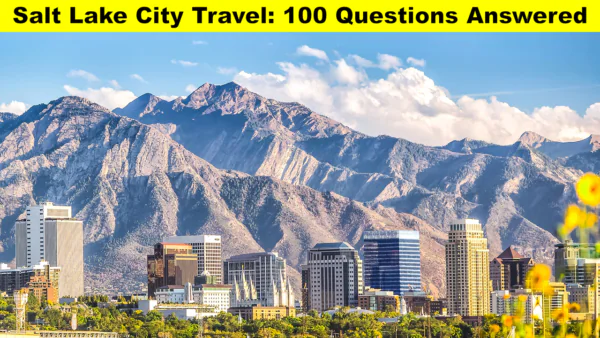
Salt Lake City Travel: 100 Questions Answered based on NeemTime research
🏔️ SLC: General Travel & Planning
Q: When is the best time to visit Salt Lake City (SLC)?
A: It depends on your interests. Winter is best for skiing/snowboarding (“The Greatest Snow on Earth”). Spring/Fall offer ideal mild weather for hiking and national parks. Summer is great for city events and is very dry and hot.
Q: Is Salt Lake City expensive to visit?
A: It can be comparable to other major Western US cities. Skiing is very expensive, but accommodations, food, and non-ski activities are generally mid-range.
Q: How many days should I spend in Salt Lake City proper?
A: 2-3 full days are enough to see the main city sights. Add 1-2 more days for mountain excursions or day trips like Park City.
Q: What is the altitude of Salt Lake City?
A: The valley floor is approximately 4,330 feet (1,320 meters). The ski resorts go up to 11,000+ feet, so be prepared for altitude sickness.
Q: What should I know about the weather and climate?
A: It has four distinct seasons. It’s a high-altitude desert climate: cold, snowy winters and hot, dry summers.
Q: How should I dress when visiting?
A: Dress in layers! Even in summer, evenings cool down. In winter, be prepared for freezing temperatures and snow gear if going to the mountains. Sunscreen and chapstick are essential year-round due to the altitude and dry air.
Q: Is Salt Lake City safe for tourists?
A: Generally, yes. Downtown is safe, especially in the main tourist areas (Temple Square, City Creek, Convention Center), but standard city awareness is always advised.
Q: Is the Temple Square construction finished?
A: No, major renovations are ongoing and are expected to continue until around 2026. Many buildings are closed, but the grounds and some visitor centers are still accessible.
Q: What are some good non-touristy things to do?
A: Explore neighborhood parks (Liberty Park, Sugar House Park), visit a local brewery (like Squatters or Uinta), or check out the eclectic shops in the 9th & 9th or Sugar House districts.
Q: Where can I get a good view of the city?
A: The Utah State Capitol steps, Ensign Peak hike, or the observation deck at the Natural History Museum of Utah.
🚗 Getting Around & Transportation
Q: Do I need to rent a car in Salt Lake City?
A: If you plan on visiting the national parks, canyons, ski resorts, or Park City, a car is recommended. For only downtown and university area sightseeing, the public transit (UTA) is sufficient.
Q: How far is the airport (SLC) from downtown?
A: The Salt Lake City International Airport (SLC) is very close, about a 10-15 minute drive to downtown.
Q: How does the TRAX light rail work from the airport?
A: The Green Line connects the airport directly to downtown. It’s a cost-effective and easy way to get to many hotels.
Q: Is there a “Free Fare Zone” downtown?
A: Yes, the UTA TRAX system has a Free Fare Zone in the core downtown area, making it free to hop on and off within that boundary.
Q: What’s the best way to get to the ski resorts?
A: The UTA ski bus is a great, economical option that runs from the valley up Big and Little Cottonwood Canyons during ski season. Otherwise, you’ll need a 4WD/AWD vehicle with snow tires or chains during snowstorms.
Q: How is Uber/Lyft availability?
A: Excellent in downtown and the immediate suburbs. Can be sparse or more expensive when leaving the city for remote trailheads or far-flung towns.
Q: What is “FrontRunner”?
A: It’s the commuter rail line that runs North and South along the Wasatch Front, connecting Ogden, Salt Lake City, and Provo.
Q: Are the downtown streets easy to navigate?
A: Yes, SLC uses a very logical, numbered grid system based on the intersection with Temple Square (e.g., 400 S 200 E).
Q: How is parking downtown?
A: Plenty of metered street parking and garages are available. Street parking is often free after 6 PM on weekdays and all day Sunday.
Q: Is it difficult to drive in the snow in SLC?
A: The valley roads are typically plowed quickly. The main difficulty is driving in the canyons, where chains or 4WD/AWD are often required by law during storms.
⛪ Mormon Culture & History
Q: Do I have to be a member of the Church of Jesus Christ of Latter-day Saints (LDS/Mormon) to visit Temple Square?
A: No. Temple Square and its grounds are open to all visitors.
Q: Can I go inside the Salt Lake Temple?
A: No, non-members or those without a “Temple Recommend” (a specific pass for active members) cannot enter the temple itself. However, there will be a public open house after the current renovations are completed (estimated 2027).
Q: What can I see at Temple Square while it’s under renovation?
A: You can see the historic grounds, the Assembly Hall, the Tabernacle, and the two Visitor Centers (when open). Missionaries are available for free tours and questions.
Q: Where can I see the Tabernacle Choir at Temple Square perform?
A: They typically hold a public rehearsal on Thursday evenings and a live broadcast on Sunday mornings. Check their schedule for location (usually the Tabernacle or Conference Center).
Q: How much of Salt Lake City is actually “Mormon”?
A: Salt Lake City proper has a minority LDS population, making it one of the least Mormon parts of the state. You will find a diverse, thriving, and secular culture, especially downtown.
Q: What is the Family History Library?
A: Located near Temple Square, it’s the world’s largest genealogical library, run by the LDS Church. It is free and open to the public for family research.
Q: What is the “This Is The Place Heritage Park”?
A: It’s a living history museum that commemorates the arrival of the Mormon pioneers in 1847 and showcases early Utah life.
Q: Will missionaries approach me?
A: Missionaries are often on and near Temple Square and may politely offer a tour or answer questions about the church. You are welcome to decline.
Q: Where is the best place to learn about the pioneer history?
A: The Church History Museum and the Pioneer Museum near the Capitol are excellent.
Q: Do I need to be respectful of religious values when visiting?
A: Yes, just as you would in any city. Be respectful in sacred spaces, but otherwise, SLC is a modern city where you can dress and act as you normally would.
🍽️ Food & Drink
Q: What local food must I try?
A: Fry Sauce (a local blend of ketchup and mayonnaise), a Utah Scone (a deep-fried dough, often served with honey butter), and pastrami burgers.
Q: Is Red Iguana really worth the wait?
A: It is a local legend known for its specialty moles and is generally considered a must-try for Mexican food. Go during off-peak hours to minimize the wait.
Q: What are the main points of Utah’s unique liquor laws?
A: Draft beer is 5% ABV. Cocktails and spirits are generally limited to 1.5 ounces of primary liquor. You must purchase full-strength liquor and wine at State Liquor Stores (DABC stores). You need to show ID, and in bars, they often scan it.
Q: Where can I find a good craft brewery?
A: Squatters Pub Brewery, Uinta Brewing, and Red Rock Brewing are popular local spots with good food and a variety of local brews.
Q: Where can I get a great cup of coffee?
A: Downtown favorites include Publik Coffee Roasters, La Barba Coffee, and Blue Copper Coffee Roasters.
Q: What’s a good fancy/splurge restaurant?
A: Look for places like Log Haven (unique canyon setting), Hell’s Backbone Grill (seasonal, sustainable), or Valter’s Osteria (Italian).
Q: What are the best cheap eats?
A: A pastrami burger from Crown Burgers or Astro Burger, a slice from The Pie Pizzeria (a local favorite), or a burrito from a local hole-in-the-wall.
Q: Where is the best place for brunch?
A: The Grand America Hotel offers a famously lavish Sunday brunch. For a more casual spot, try Roots Cafe or The Park Cafe.
Q: What is a “soda shop” in Utah?
A: A unique Utah experience where you order custom-mixed sodas with flavored syrups, purees, and cream (e.g., Swig or Sodalicious).
Q: Do bars close early in Salt Lake City?
A: Most bars have last call at 1:00 AM, and patrons must finish their drinks and leave by 2:00 AM.
🏞️ Outdoors & Day Trips (Non-Skiing)
Q: Can I swim in the Great Salt Lake?
A: Yes, but the best place is at Bridger Bay Beach on Antelope Island State Park. The high salinity allows you to float like a cork.
Q: Is Antelope Island State Park worth the drive?
A: Absolutely. It’s a beautiful spot for scenic drives, short hikes, and seeing wildlife like bison, antelope, and bighorn sheep.
Q: Where are the best places for an easy/moderate day hike near SLC?
A: Ensign Peak (short hike, great city views), The Living Room Trail (moderate, fun rock furniture view spot), and trails in Big Cottonwood Canyon.
Q: What is Park City like, and is it worth a day trip?
A: Yes, it’s a worthwhile 40-minute drive. It’s a historic former mining town with a quaint Main Street, boutique shopping, and the Utah Olympic Park.
Q: What can I do at the Utah Olympic Park?
A: You can tour the venue of the 2002 Winter Olympics, see ski jumps, and, in summer, try activities like the Comet Bobsled Ride or extreme tubing.
Q: What’s the best scenic drive near the city?
A: Driving up Big Cottonwood Canyon or Little Cottonwood Canyon offers stunning mountain views any time of year.
Q: Is a trip to the Bonneville Salt Flats worth it?
A: It’s about a 1.5-hour drive west. If you’re looking for a truly unique, otherworldly photo opportunity and don’t mind the drive, it’s worth it. Check conditions before going.
Q: How far are the “Mighty 5” National Parks from SLC?
A: They are far. The closest is Capitol Reef (3.5-4 hours), then Arches/Canyonlands (4-4.5 hours), and Zion/Bryce (4.5-5 hours). They are better as a multi-day trip.
Q: Are there any warnings I should know about for hiking?
A: Hydrate aggressively (altitude + dry air), be aware of rattlesnakes on warmer trails, and always check the weather for sudden changes.
Q: Is it safe to see wildlife like moose or bears?
A: Wildlife encounters are possible, especially in the canyons. Keep a safe distance from moose (they can be aggressive) and never feed any animal. Bear spray is generally not necessary but can be carried in deep wilderness.
⛷️ Winter/Skiing Questions
Q: Why is Utah skiing called “The Greatest Snow on Earth”?
A: The region receives a unique combination of cold, dry air and a specific storm track, resulting in low-density, light, and fluffy snow (powder).
Q: What is the difference between Big and Little Cottonwood Canyons?
A: Little Cottonwood Canyon is home to Alta (ski only) and Snowbird (ski/snowboard). Big Cottonwood Canyon is home to Brighton and Solitude (both ski/snowboard).
Q: Can I ski and snowboard at all resorts?
A: No, Alta and Deer Valley (in Park City) are ski-only. Snowbird, Brighton, Solitude, and Park City Mountain Resort allow both.
Q: How far are the ski resorts from the airport?
A: The closest four resorts (Alta, Snowbird, Solitude, Brighton) are only about 35-45 minutes from the airport (without traffic or weather delays).
Q: What’s the best time for deep powder skiing?
A: Mid-January through early March typically offers the best chances for deep, reliable powder.
Q: How do I avoid canyon traffic on a powder day?
A: Leave very early (before 7 AM), take the UTA Ski Bus, or ski on a weekday. The canyons can get very backed up.
Q: What are the chain/tire laws for the canyons?
A: During storms, the Utah Department of Transportation (UDOT) enforces canyon restrictions. This can require 4WD/AWD with snow-rated tires (M+S or 3-peak mountain snowflake) or chains for all other vehicles.
Q: Is there a gondola or tram I can ride in the winter without skiing?
A: Yes, the Snowbird Tram is often open to non-skiers for sightseeing and lunch at the summit restaurant.
Q: Where can I rent ski/snowboard equipment?
A: There are rental shops in the city (often cheaper) or at the base of the resorts (more convenient).
Q: Is it possible to go tubing or sledding near SLC?
A: Yes, look for snow tubing parks like Woodward Park City or Soldier Hollow for dedicated lanes and lifts.
🏛️ Arts, Culture, & Museums
Q: What are the top museums in Salt Lake City?
A: The Natural History Museum of Utah (NHMU), The Leonardo (art, science, and tech), and the Utah Museum of Fine Arts (UMFA).
Q: Where is the best place to see dinosaur fossils?
A: The Natural History Museum of Utah has excellent displays focused on Utah and the Intermountain West’s prehistoric history.
Q: Is the Utah State Capitol Building worth visiting?
A: Yes, the architecture is impressive (resembling the US Capitol), and the dome and rotunda are beautiful. It offers excellent panoramic views of the city.
Q: Where can I see a performance?
A: The Eccles Theater for Broadway shows, the Capitol Theatre for opera and ballet, and the Abravanel Hall for the Utah Symphony.
Q: What’s the Clark Planetarium like?
A: It’s a great spot for science enthusiasts, offering an IMAX theater and a dome theater for celestial shows.
Q: What’s a good place for contemporary art?
A: The Utah Museum of Contemporary Art (UMOCA) or the galleries in the Gateway shopping center.
Q: Where is the Red Butte Garden and Arboretum?
A: Located near the University of Utah, it’s a beautiful botanical garden that also hosts a popular outdoor concert series in the summer.
Q: What is Dreamscapes?
A: It was a popular immersive, multi-sensory art experience, but check its current status and location, as it changes.
Q: Is the Hogle Zoo worth a visit?
A: It’s a mid-sized, well-regarded zoo that’s great for a family-friendly half-day outing.
Q: Where can I find local shopping?
A: City Creek Center (downtown, modern, retractable roof) and the streets of Sugar House and 9th & 9th for local boutiques.
☀️ Summer Activities
Q: What’s a great summer activity with kids?
A: Visiting the Loveland Living Planet Aquarium (technically in Draper) or playing at Liberty Park.
Q: Are there outdoor concerts in the summer?
A: Yes, the Red Butte Garden Amphitheatre hosts a major summer concert series, and there are many smaller, free concerts in various parks.
Q: Can I hike in the canyons in the summer?
A: Yes, the summer is the prime hiking season. Start early to avoid the midday heat.
Q: Where can I go paddle boarding or kayaking near SLC?
A: Local reservoirs like Jordanelle State Park (near Park City) or Deer Creek State Park are popular spots.
Q: Is there a big summer festival?
A: The Utah Arts Festival (late June) and the Pioneer Day celebrations (July 24th) are major summer events.
Q: What is the “Twilight Concert Series”?
A: A popular outdoor music festival held in downtown Salt Lake City, featuring a diverse lineup of touring musicians.
Q: Is it safe to hike to the top of Mount Timpanogos?
A: Mount Timpanogos is a strenuous, all-day hike for experienced, fit hikers. It’s not a casual activity.
Q: Where can I rent a bike to ride around the city?
A: The GREENbike shared bike system is available for short trips downtown and in adjacent areas.
Q: What is the Trapper’s Loop Scenic Byway?
A: A popular drive that connects the Ogden Valley to the I-80 corridor near Park City, offering stunning views and less traffic than the main highways.
Q: Is fishing popular near Salt Lake City?
A: Yes, the reservoirs and streams in the Cottonwood Canyons are popular for trout fishing (with a valid license).
🏘️ Neighborhoods & Accommodation
Q: What is the best neighborhood to stay in for first-time visitors?
A: Downtown is the most convenient for major attractions, nightlife, and public transit access.
Q: What is Sugar House like?
A: A trendy, walkable, and vibrant neighborhood southeast of downtown with local shops, restaurants, and a large park. A good option if you want to be close to, but not right in, the city center.
Q: What is the 9th & 9th neighborhood known for?
A: A smaller, bohemian-like pocket known for unique boutiques, independent eateries, and local cafes.
Q: Should I stay near the airport or downtown?
A: Downtown. The airport area is primarily hotels, while downtown offers much more walkable access to attractions, restaurants, and entertainment.
Q: What hotels are known for great views?
A: High-rise hotels downtown, like the Grand America Hotel or the Little America Hotel, often have good city and mountain views.
Q: Is staying in Park City a good alternative to SLC?
A: Yes, but it’s more expensive and less central. Stay in Park City if your primary goal is high-end skiing, Sundance, or a mountain-town experience.
Q: What is The Gateway area?
A: A revitalized outdoor shopping and entertainment area downtown, home to the Clark Planetarium, shops, and restaurants.
Q: What is the “Avenues” neighborhood?
A: A historic, quiet, residential area on the hills north of downtown, known for its older homes, views, and close proximity to hiking trails.
Q: Where are the best places for nightlife/bars?
A: Main Street downtown, especially around 200 South, has a concentration of popular bars and lounges.
Q: Are there any unique Airbnbs or boutique hotels?
A: Look for boutique hotels like Hotel Monaco downtown or explore listings in the Sugar House or 9th & 9th neighborhoods for unique local stays.
🎁 Miscellaneous Tips & Quirks
Q: How should I handle the high altitude?
A: Drink extra water, limit alcohol and caffeine on the first day, and take it easy with strenuous activity until you acclimate.
Q: Where can I see a professional sports team?
A: The Utah Jazz (NBA) play downtown at the Delta Center, and Real Salt Lake (RSL) (MLS) plays just south of the city.
Q: Where can I buy wine and strong liquor?
A: At one of the state-run Utah Department of Alcoholic Beverage Control (DABC) liquor stores. They have limited hours and are closed on Sundays and holidays.
Q: What is the most scenic spot for a photo?
A: The Great Salt Lake sunset from Antelope Island, or a classic shot of the city skyline framed by the mountains from the Capitol.
Q: What is “Ski City”?
A: A marketing term for Salt Lake City, highlighting its unique proximity to four world-class ski resorts (Alta, Snowbird, Brighton, Solitude).
Q: Can I use the bus to get to all the ski resorts?
A: Yes, the UTA ski buses serve Alta, Snowbird, Brighton, and Solitude.
Q: Is there a good spot to buy local souvenirs?
A: City Creek Center, local gift shops in Sugar House, or the gift shops at the Natural History Museum and Temple Square.
Q: What is the traffic like during rush hour?
A: Normal big-city congestion, especially on I-15 and the main canyon roads (Big and Little Cottonwood) in the morning and evening.
Q: Is there a time of year when the city is quiet?
A: Late spring (May) and early fall (September/October) can be beautiful for weather but less busy than the summer festival season or peak ski season.
Q: Where can I find out about local events during my visit?
A: Check websites like NowPlayingUtah.com or the local city blogs/newspapers for up-to-date calendars.