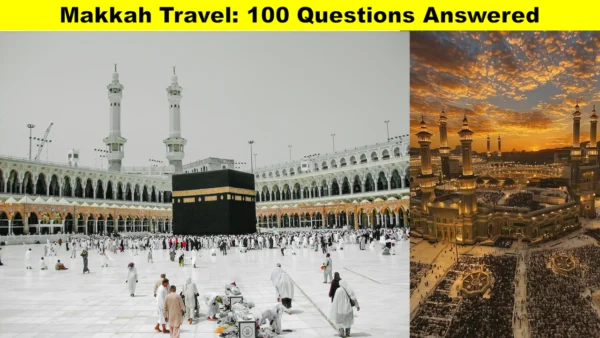
Makkah Travel: 100 Questions Answered based on NeemTime research
Part 1: Visas, Legalities, and Entry Requirements
1. Who is allowed to enter Makkah? Only Muslims are permitted to enter the holy city of Makkah. Non-Muslims are legally prohibited from entering the city limits.
2. Can I perform Umrah on a standard Saudi Tourist Visa? Yes, Saudi Arabia allows holders of the Electronic Visa (e-Visa) or Visa on Arrival to perform Umrah. You do not strictly need a dedicated Umrah visa unless you are booking a specific package through an authorized agent.
3. What is the difference between an e-Visa and an Umrah Visa? The e-Visa is a multiple-entry visa valid for one year, allowing you to travel across Saudi Arabia for tourism and Umrah. An Umrah visa is typically a single-entry visa valid for up to 90 days, specifically tied to religious travel and often required for citizens of countries not eligible for the e-Visa.
4. Do I need an official permit to perform Umrah? Technically, yes. You are supposed to book your Umrah slot via the official Nusuk application. While physical checks at the entry gates vary, having the digital permit on your phone is required.
5. Do women still need a Mahram (male guardian) to travel to Makkah? No, Saudi Arabia has officially lifted the Mahram requirement. Women are now legally allowed to travel to Makkah and perform Umrah alone or in groups without a male guardian.
6. Can citizens of GCC countries travel to Makkah without a visa? Yes, citizens of Gulf Cooperation Council (GCC) countries (UAE, Oman, Bahrain, Kuwait, Qatar) only need their National ID card or passport to enter Saudi Arabia.
7. Can I get a Visa on Arrival if I hold a US, UK, or Schengen visa? Yes, if you hold a valid tourist or business visa from the US, UK, or a Schengen country, and you have used it at least once to enter that respective country, you are eligible for a Saudi Visa on Arrival.
8. How long is the stay duration on a Saudi Tourist e-Visa? The e-Visa allows for a maximum stay of 90 days per visit within its one-year validity period.
9. Is travel insurance mandatory for entry? Yes, when you apply for a Saudi e-Visa, a mandatory medical insurance fee is included in the cost. This covers emergency medical services while you are in the country.
10. Can I visit other cities like Jeddah or Riyadh if I come on an Umrah visa? Yes, the regulations have changed. Travelers on Umrah visas are now permitted to travel freely between all cities in Saudi Arabia during their valid stay.
Part 2: Flight Logistics and Airports
11. Which airport is closest to Makkah? Makkah does not have its own commercial airport. The primary gateway is King Abdulaziz International Airport (JED) in Jeddah, located about 85 kilometers away.
12. Can I fly into Prince Mohammad Bin Abdulaziz International Airport (MED) in Madinah? Yes, many travelers prefer flying into Madinah first to visit the Prophet’s Mosque, then taking the high-speed train or a bus down to Makkah.
13. Which terminal at Jeddah Airport handles Umrah pilgrims? Jeddah Airport has a dedicated Hajj/Umrah Terminal, but many international flights on commercial airlines also land at Terminal 1. Double-check your ticket, as Terminal 1 connects directly to the high-speed train station.
14. Where do I change into my Ihram if I am flying directly to Jeddah? If your flight passes over the Miqat (the boundary line where intentions must be made) while in the air, you must change into your Ihram before your flight takes off or in the aircraft restroom before crossing the Miqat. The cabin crew usually announces when the Miqat is approaching.
15. Is it better to put on the Ihram clothing at home or at a layover airport? It is highly recommended to put on the two pieces of cloth during a layover at a transit airport (like Dubai, Doha, or Istanbul) to avoid the cramped spaces of an airplane restroom.
16. What is the baggage allowance for Zamzam water on return flights? Most major airlines allow you to check in one 5-liter bottle of Zamzam water per passenger as a separate piece of baggage for free or a nominal fee, provided it is packed in the official airport-sealed plastic packaging.
17. Can I buy Zamzam water at Jeddah or Madinah airports? Yes, official, factory-sealed 5-liter bottles of Zamzam water are sold at designated counters right outside the departure terminals. You cannot bring unsealed water bottles onto the aircraft.
18. Are there showers available at Jeddah Airport to freshen up before changing into Ihram? Terminal 1 has premium lounges that offer shower facilities for a fee or via credit card access programs. Free public showers are limited and often crowded.
19. How early should I arrive at Jeddah Airport for my flight home? Due to heavy crowds and security checkpoints, it is widely recommended to arrive at least 3 to 4 hours before an international flight.
20. Can I take a taxi directly from Jeddah Airport to my hotel in Makkah? Yes, official airport taxis, private ride-hailing services like Uber and Careem, and pre-booked hotel drivers can take you directly from the airport terminal to Makkah.
Part 3: Transportation and Commuting
21. What is the Haramain High-Speed Railway? It is a bullet train that connects Jeddah Airport, Jeddah Central, Makkah, and Madinah. It is the fastest and most comfortable way to travel between these destinations.
22. How long does the train ride take from Jeddah Airport to Makkah? The train journey from King Abdulaziz International Airport station to the Makkah station takes approximately 55 minutes.
23. Where is the Makkah train station located? The Haramain station in Makkah is located in the Al-Rusaifah district, which is about 4 kilometers away from the Grand Mosque (Masjid al-Haram). You will need a short taxi or bus ride to reach the Haram.
24. How far in advance should I book Haramain train tickets? Tickets open online roughly an upper limit of a month in advance. It is highly advised to book at least 1 to 2 weeks early, especially for weekends and during Ramadan, as seats sell out quickly.
25. Can I bring large suitcases on the Haramain train? Each passenger is allowed one large suitcase (up to 25kg) and one small hand-carry item. Oversized luggage may require booking a special cargo service or taking a taxi instead.
26. Are Uber and Careem widely available in Makkah? Yes, both ride-hailing apps work perfectly in Makkah. They offer transparent pricing and eliminate the need to negotiate fares with traditional taxi drivers.
27. Do public buses operate near the Haram? Yes, the Makkah Bus project runs an extensive network of modern, air-conditioned buses connecting various residential districts and hotels directly to stations near the Grand Mosque.
28. How much does a typical taxi cost from Makkah station to the Grand Mosque? Depending on traffic and peak prayer times, fares usually range from 20 to 50 Saudi Riyals (SAR).
29. Is it easy to find a taxi right after Friday prayers? No, roads around the Haram are blocked for pedestrian safety right before and after prayers. It is best to wait 45 to 60 minutes in a nearby cafe until traffic normalizes.
30. Can I rent a car and drive into Makkah myself? You can rent a car, but driving within central Makkah is highly discouraged due to extreme congestion, confusing road closures, and a lack of public parking near the Haram.
Part 4: Accommodation and Lodging
31. What are the best areas to stay in Makkah? The Abraj Al Bait (Clock Tower) complex and Jabal Omar complex offer the closest luxury accommodations. For budget-conscious travelers, areas like Mahbas Al-Jin, Aziziyah, and Misfalah offer cheaper options with shuttle bus services.
32. What does “Haram View” actually mean when booking a hotel? A “Haram View” room usually offers a view of the outer courtyard of the Grand Mosque. If you want to see the Kaaba specifically, look explicitly for a “Kaaba View” room, which usually commands a heavy premium.
33. Do budget hotels away from the Haram provide free transport? Yes, most hotels located 1 to 3 kilometers away in areas like Mahbas Al-Jin provide complimentary, 24/7 shuttle buses that drop pilgrims off at designated bus terminals near the Haram.
34. Is it possible to pray in the hotel room while following the Imam of the Haram? Many hotels in the Clock Tower and Jabal Omar have linked audio systems connected directly to the Haram’s microphones. If your room or hotel prayer hall has a direct line of sight to the rows of worshipers, praying along is common, though visiting the mosque is always preferred.
35. What are the check-in and check-out times for Makkah hotels? Standard check-in is usually at 4:00 PM, and check-out is at 12:00 PM. Hotels are strict about these times due to high turnover rates.
36. Is tap water safe to drink in Makkah hotels? It is generally not recommended to drink tap water directly. Hotels routinely provide free bottled water, and bottled water is very inexpensive to purchase at local groceries.
37. Do Makkah hotels have laundry facilities? Most hotels offer laundry services, but they can be expensive. Many pilgrims use the small independent laundry shops (labeled “Maghsala”) found in the streets behind the hotels, which are cheap and quick.
38. Can I book a hotel upon arrival, or must I book in advance? Always book in advance. Makkah runs at high occupancy year-round, and walk-in rates are drastically higher, assuming rooms are even available.
39. Are there accessible rooms for wheelchair users? Yes, major international hotel chains in Makkah offer excellent wheelchair-accessible rooms and step-free access to the main malls and courtyards.
40. What is the electrical plug type used in Makkah? Saudi Arabia uses the Type G plug (three-pin UK style), running on a 230V supply and 60Hz frequency.
Part 5: The Rituals of Umrah
41. What are the core steps of Umrah? The four essential steps are: assuming the state of Ihram, performing Tawaf (seven circumambulations around the Kaaba), performing Sa’i (seven trips between the hills of Safa and Marwa), and Halq or Taqsir (shaving or cutting the hair).
42. What is the Ihram clothing for men? It consists of two white, unstitched sheets of cloth: the Izar (wrapped around the waist) and the Rida (draped over the shoulders). No underwear, socks, or head cover are allowed.
43. What is the Ihram clothing for women? Women do not wear specific white cloths; they can wear their ordinary, modest clothing that covers the full body except for the face and hands.
44. What happens if I violate an Ihram rule by mistake? If a rule is broken out of genuine forgetfulness or ignorance, there is no penalty, but you must correct it immediately. For intentional violations or prolonged exposure, a penalty (Dam), such as sacrificing a sheep or feeding the poor, may be required.
45. Can I use scented soap or deodorant while in Ihram? No, using any scented soaps, perfumes, colognes, or deodorants is strictly forbidden once you enter the state of Ihram. Unscented toiletries must be used.
46. Where does the Tawaf begin and end? Tawaf begins and ends at the corner of the Kaaba where the Black Stone (Hajar al-Aswad) is embedded, marked by a green light on the mosque wall opposite it.
47. Is it mandatory to kiss the Black Stone? No. Due to massive crowds, kissing it is rarely possible. It is perfectly sufficient to raise your right hand toward it from a distance and say Bismillah, Allahu Akbar at the start of each circuit.
48. Can women perform Umrah while menstruating? No, women in a state of ritual impurity cannot perform Tawaf or enter the prayer areas of the mosque. They must wait until their cycle ends, perform a ritual bath (Ghusl), and then fulfill their Umrah.
49. How long does it take to complete a full Umrah? On average, a regular Umrah takes between 2 to 4 hours, depending on crowd density, walking pace, and whether you are performing Tawaf on the ground floor or upper floors.
50. Can I perform multiple Umrahs on a single trip? Yes. To perform a subsequent Umrah, you must travel out to the city boundary—most commonly to Masjid Aisha in Taneem—to renew your Ihram and intention, and then return to the Haram.
Part 6: Weather, Health, and Safety
51. What is the best time of year to visit Makkah weather-wise? The winter months from November to February offer the most pleasant weather, with cooler daytime temperatures and comfortable evenings.
52. How hot does it get in Makkah during the summer? Summer temperatures (June through August) routinely exceed 45 degrees Celsius (113 degrees Fahrenheit). Daytime outdoor activities should be minimized.
53. How do I avoid severe dehydration during Tawaf? Drink plentiful amounts of Zamzam water, which is available throughout the Haram in coolers. Try to schedule your outdoor rituals during late-night or early-morning hours.
54. What should I do if I get blisters on my feet from walking barefoot? Clean the area immediately after your rituals, apply an antiseptic cream, and wear comfortable footwear outside the mosque. You are allowed to wear clean, soft socks during Sa’i if your feet are injured.
55. Are there medical clinics inside the Grand Mosque? Yes, there are several free, 24/7 emergency medical centers and first-aid stations located within the Haram complex to treat heat stroke, exhaustion, or minor injuries.
56. Is Makkah safe for solo female travelers? Yes, Makkah is considered exceptionally safe. There is a heavy presence of security personnel, and the overall spiritual environment keeps crime rates very low.
57. How do I prevent getting the “Hajj/Umrah Cough”? The massive gathering of international crowds makes respiratory viral infections common. Wear a high-quality face mask in crowded spaces, use hand sanitizer frequently, and consider getting a flu shot before traveling.
58. What happens if I lose my group or get lost inside the Haram? Pick a highly visible landmark outside the mosque (such as a specific gate number or hotel tower entrance) as a designated meeting spot before you enter. Avoid trying to find people inside the multi-level halls.
59. Can I bring my prescription medications into Saudi Arabia? Yes, bring medications in their original packaging accompanied by a clear, official doctor’s prescription.
60. Are wheelchairs available for elderly pilgrims? Yes, the Haram provides free manual wheelchairs (though you may need to hire someone to push them), and there is a dedicated upper floor for renting automated electric scooters to complete Tawaf and Sa’i.
Part 7: Currency, Banking, and Connectivity
61. What is the local currency in Saudi Arabia? The local currency is the Saudi Riyal (SAR). It is pegged to the US Dollar at a stable rate of approximately 1 USD = 3.75 SAR.
62. Are credit cards widely accepted in Makkah? Yes, Visa and Mastercard are accepted almost everywhere, including hotels, malls, supermarkets, and major restaurants. However, carry some cash for small street vendors, taxis, and barbers.
63. Where can I exchange money near the Haram? There are numerous authorized currency exchange booths located in the shopping malls directly underneath the Clock Tower and Jabal Omar hotels.
64. Can I withdraw cash from local ATMs using an international card? Yes, international debit cards work at Saudi ATMs, subject to standard foreign transaction and withdrawal fees from your home bank.
65. How do I get a local SIM card upon arrival? Local telecom operators like STC, Mobily, and Zain have prominent kiosks right inside the arrivals hall at Jeddah Airport and inside the major malls around the Haram. You will need your passport to register a number.
66. Is eSIM available for tourists in Saudi Arabia? Yes, you can purchase an eSIM online before arrival through global apps like Airalo, or purchase a local eSIM package directly from Saudi providers.
67. Is there free Wi-Fi inside the Grand Mosque? While there are public Wi-Fi networks available around the central area, they can be unreliable and slow due to the immense volume of concurrent users. Relying on cellular data is recommended.
68. Do I need cash to tip service workers in Makkah? Tipping is not deeply embedded in Saudi culture, but small tips for hotel porters, taxi drivers, or cleaners are appreciated.
69. What is the cheapest way to make international calls home? Use internet-based calling services over mobile data or hotel Wi-Fi. Note that some VoIP services face intermittent restrictions, so using popular messaging apps is standard practice.
70. Should I buy a data plan with unlimited data? If you plan to live-stream or make frequent video calls to family back home while at the holy sites, an unlimited or high-cap data plan is highly recommended.
Part 8: Food, Dining, and Daily Life
71. What kind of food options are available near the Haram? The dining landscape is incredibly diverse. The food courts in the Clock Tower and Jabal Omar malls offer global fast-food chains, alongside traditional Middle Eastern, South Asian, and Southeast Asian cuisines.
72. Are all restaurants in Makkah Halal? Yes, by law, all food served across the entire Kingdom of Saudi Arabia is strictly Halal.
73. What are the dining options during the month of Ramadan? During Ramadan, restaurants close during the daytime hours. They open up shortly before sunset for Iftar and remain open throughout the night until Suhoor (dawn).
74. Is food expensive in Makkah? Food in hotel restaurants and the immediate mall food courts can be pricey, but if you walk a few blocks into the local neighborhoods (like Misfalah or Shubaika), you will find cheap, authentic eateries.
75. What is the tap water policy for washing fruits? You can use tap water to wash fruits and vegetables, but many travelers prefer to give them a final rinse with bottled water just to be safe.
76. Do shops and malls close during prayer times? Historically, all shops closed completely during prayers. Today, regulations are relaxed, and many establishments keep their doors open or allow customers to remain inside, though active service often pauses for 15-20 minutes.
77. What is the standard weekend in Saudi Arabia? The official weekend runs on Friday and Saturday. Fridays are exceptionally busy around the Haram due to the congregational Jumu’ah prayer.
78. Where can men get their head shaved after Umrah? There are dozens of licensed barber shops located in the plazas and basement levels around the Haram (especially under the Clock Tower). Ensure the barber uses a brand-new, disposable single-use blade.
79. Can women cut their own hair to exit Ihram? Yes, a woman does not go to a public barber. She can exit Ihram in the privacy of her room by cutting a small portion of her hair equivalent to the length of a fingertip from the ends of her tresses.
80. Is there a dress code for walking around Makkah when not in Ihram? Yes, modest clothing is expected. Men should avoid short shorts or sleeveless shirts in public, and women should wear loose-fitting clothes that cover their shoulders and legs. A headscarf is universally worn by women in Makkah.
Part 9: Historical Sites and Ziyarat
81. What does “Ziyarat” mean? Ziyarat refers to visiting historical and religiously significant landmarks in and around the holy cities.
82. What are the main Ziyarat sites in Makkah? Key sites include Jabal al-Noor (Cave of Hira), Jabal Thawr, Mount Arafat (Jabal al-Rahmah), Muzdalifah, Mina, and the Jannat al-Mu’alla cemetery.
83. How can I book a Ziyarat tour? You can easily hire a local private taxi driver outside your hotel, join an organized bus tour booked through your hotel desk, or utilize ride-hailing apps to visit specific sites individually.
84. Is it possible to climb up to the Cave of Hira? Yes, but it requires a strenuous uphill trek taking anywhere from 45 minutes to 2 hours depending on physical fitness. It should only be attempted in the early morning or evening to avoid severe heat.
85. Are there facilities like toilets at the Ziyarat sites? Major sites like Mount Arafat have basic facilities, but smaller historical locations have minimal infrastructure. Plan your restroom breaks accordingly.
86. Can you enter the actual tents in Mina during a regular tour? No, the massive tent city of Mina is fenced off, locked, and closed to the general public outside the official days of the Hajj pilgrimage.
87. What is the significance of Jannat al-Mu’alla? It is the historic cemetery in Makkah where many family members of the Prophet Muhammad, including his first wife Khadijah, are buried.
88. How much does a typical 3-hour Ziyarat taxi tour cost? Depending on your negotiating skills and the season, a private car tour for 4 people usually costs between 150 to 300 SAR.
89. Can I visit these historical sites using the public Makkah Bus? Some routes pass close to areas like Mina and Muzdalifah, but for a comprehensive sightseeing trip encompassing multiple locations efficiently, a dedicated taxi or tour is preferred.
90. Is it allowed to pray formal prayers at the historical mountains? Worshipers can pray optional prayers anywhere clean, but building specific rituals or seeking blessings from the physical rocks or soil is discouraged.
Part 10: Apps, Tech, and Modern Etiquette
91. What are the absolute must-have mobile apps for the trip? You should download Nusuk (for Umrah and Rawdah permits), Tawakkalna (the national multi-service app), Careem/Uber (for transport), and Google Maps (for navigation).
92. Am I allowed to take photos and videos inside the Grand Mosque? Taking photos and videos for personal memories with smartphones is generally tolerated. However, setting up professional tripods, large cameras, or blocking walkways to film social media content is strictly forbidden and security will intervene.
93. Can I do a video call while standing right in front of the Kaaba? While many people do it briefly to show family at home, it is frowned upon if it causes blockages in the crowd or disrupts the focus of surrounding worshipers. Keep it discreet and brief.
94. Is there a penalty for taking photos of security personnel? Yes, taking photos or videos of military personnel, security guards, or government checkpoints is illegal in Saudi Arabia and can lead to immediate deletion of files or confiscation of your phone.
95. How do I keep my phone safe while performing the rituals? Keep your phone, cash, and passports in a secure, zippered waist pouch or cross-body bag worn underneath your Ihram or clothing. Avoid putting valuables in loose pockets.
96. Can I bring a power bank inside the Haram? Yes, small personal power banks are allowed inside the mosque to keep your phone charged, which is crucial since your permits are digital.
97. Are Bluetooth headphones allowed during Tawaf? Yes, many pilgrims use a single earbud to listen to Quran recitations, du’a guides, or translations while performing their circuits, provided it doesn’t distract them from the environment.
98. How do I find out the exact prayer times for Makkah? Prayer times change daily with the sun. You can check them via standard Islamic smartphone apps, the Nusuk app, or simply by listening for the loud, city-wide Adhan (call to prayer).
99. What should I do with my shoes when entering the Grand Mosque? You can place your shoes in the numbered shoe racks located near every entrance. To avoid losing them in a different exit, carry a small, lightweight string bag to keep your shoes with you throughout your time inside.
100. Is there a lost and found center at the Haram? Yes, there are designated lost and found offices managed by the mosque authorities. If you lose an item of value, you can approach any guard who will direct you to the nearest branch.