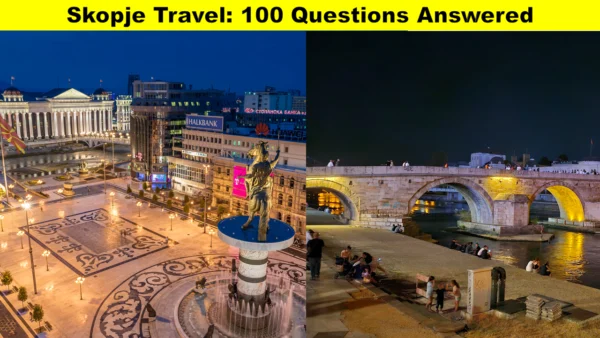
Skopje Travel: 100 Questions Answered based on NeemTime research
Essentials & Planning
Is Skopje safe for solo travelers? Yes, it is generally very safe, though standard precautions against pickpockets in crowded areas like the Old Bazaar apply.
What is the best time to visit? May, June, and September offer the best weather. July and August can be scorching (above 40°C).
How many days do I need? 2 days is enough for the city highlights; 3-4 days if you include Matka Canyon and Vodno.
Do I need a visa? Most Western citizens (EU, US, UK, CA) can enter visa-free for 90 days.
Is the tap water drinkable? Yes, Skopje’s tap water is safe and quite tasty.
What is the local currency? The Macedonian Denar (MKD).
Can I use Euros? Officially no, but some hotels and taxis might accept them at a poor rate. Use Denars for everything else.
Are credit cards widely accepted? Yes, in malls and restaurants, but keep cash for the Old Bazaar and small kiosks.
What’s the “statue situation”? The “Skopje 2014” project filled the center with hundreds of statues to boost national identity; locals have mixed feelings, but tourists find it surreal.
Is there Uber or Lyft? No. Use local taxi apps like Cammeo or call a taxi.
Do I need to tip? Rounding up is common; 10% is appreciated for good service in restaurants.
Is English widely spoken? Yes, especially among younger people and in the tourism sector.
What is the main religion? Primarily Orthodox Christian, with a significant Muslim minority.
Is it expensive? No, it is one of the most budget-friendly capitals in Europe.
What is the “Warrior on a Horse”? It’s a massive statue of Alexander the Great (though officially renamed due to disputes with Greece).
Food & Drink
What is the must-try dish? Tavce Gravce (traditional baked beans in a clay pot).
What is Ajvar? A delicious roasted red pepper spread, often eaten with bread and white cheese.
What is Rakija? A potent fruit brandy; drink it slowly with a salad (Shopska).
Where is the best food? The Debar Maalo neighborhood (the “Bohemian Quarter”).
Is there a vegetarian option? Yes, Shopska salad, Turli Tava (vegetable stew), and various cheeses.
What is Selsko Meso? A hearty “village meat” stew with mushrooms and smoked meat.
Try the Burek? Absolutely. It’s a flaky pastry filled with cheese, meat, or spinach, usually eaten for breakfast with yogurt.
What’s a “Skopsko”? The most popular local beer.
Can I find good coffee? Skopje has a massive coffee culture. Try “Turkish coffee” in the Old Bazaar or an espresso in Debar Maalo.
What is Pastrmajlija? A Macedonian “pizza” or bread pie topped with salted meat cubes.
Best place for a quick snack? Any “Pekara” (bakery) for fresh pastries.
Is dinner late? People usually start dinner around 8:00 PM or 9:00 PM.
What is Mastika? A liquor seasoned with mastic resin, similar to ouzo but different.
What is Trilece? A popular “three milks” cake found in most dessert shops.
Try the local wine? Yes, Macedonia has excellent wines, particularly the Vranec (red) and Temjanika (white).
Sights & Activities
What is the Old Bazaar (Carsija)? The second-largest Ottoman-era bazaar in the Balkans, full of tea shops and gold smiths.
Is the Stone Bridge important? Yes, it’s the symbol of the city, connecting the old and new parts.
Can I climb the Kale Fortress? Yes, it’s free and offers great views, though parts are unmaintained.
What is the Millennium Cross? A 66-meter cross on top of Mt. Vodno.
How do I get to the Cross? Take the “Millennium Cross” bus (double-decker) from the station, then the cable car.
What is Matka Canyon? A stunning nature spot 15km away with a lake, caves, and kayaking.
Can I swim in Matka? It’s very cold and not recommended; better to rent a boat.
What is the Mother Teresa Memorial House? A museum dedicated to Mother Teresa, who was born in Skopje.
Where is the best view? Either the top of the Kale Fortress or the 7th floor of the Hotel Arka.
Are museums open on Mondays? Most are closed on Mondays.
What is the Museum of the Macedonian Struggle? A wax museum depicting the country’s history; tours are mandatory.
What is the “Brutalist Walk”? Skopje was rebuilt in a brutalist style after the 1963 earthquake; check out the Main Post Office and the University Campus.
What is the 1963 Earthquake? A devastating event that destroyed 80% of the city. The old station clock is still stopped at 5:17 AM.
Should I do a walking tour? Yes, the “Free Skopje Walking Tour” is highly recommended by travelers.
Is there nightlife? Yes, during summer the City Park (Gradski Park) is full of clubs; in winter, they move indoors.
Logistics & Transport
How do I get from the airport? The “Wizz Air” shuttle bus (Vardar Ekspres) or a fixed-price taxi (about 25 Euros).
Is public transport good? There are only buses. They use a “Skopska” card you must pre-load; drivers don’t sell tickets.
Are taxis cheap? Yes, but ensure they use the meter. Start price is usually 50-60 MKD.
Can I walk everywhere? The city center is very walkable, but you’ll need transport for Matka or Vodno.
How to get to Ohrid? By bus from the main station; it takes about 3 hours.
Can I go to Pristina (Kosovo) for a day? Yes, it’s a 2-hour bus ride away.
Is there a train station? Yes, but the rail network is limited. Buses are much faster and more reliable.
Where is the bus station? It’s under the main railway bridge (the “Transporten Centar”).
Can I rent a car? Yes, but driving in the center can be chaotic.
Is there parking? Limited and usually paid via SMS or at booths.
What is “Zonata”? The parking zone system.
Are there bike rentals? Yes, the city is relatively flat and has bike lanes along the Vardar river.
Is the airport far? About 25-30 minutes by car.
Do I need to carry my passport? Technically yes, but a photo on your phone is usually fine for daily walking.
Is there free Wi-Fi? Many cafes offer it; look for “Skopje Free Wi-Fi” in the square.
Shopping & Leisure
What should I buy as a souvenir? Opanci (traditional shoes), Ajvar, or Macedonian filigree jewelry.
Where are the malls? Skopje City Mall, East Gate Mall, and Ramstore.
Is the Green Market (Zelen Pazar) worth it? Yes, for local atmosphere and fresh produce.
Can I buy a local SIM card? Yes, A1 or Makedonski Telekom have tourist plans.
Are pharmacies common? Yes, look for “Apteka.”
What are “Skopje 2014” miniatures? Small replicas of the statues sold in souvenir shops.
Is Bit Pazar safe? Yes, it’s the biggest market at the end of the Old Bazaar. Keep an eye on your wallet.
Can I bargain? Only in the Old Bazaar or Bit Pazar; prices are fixed in shops and malls.
Where is the “Bohemian Street”? Ulitsa Gjorgji Pulevski in Debar Maalo.
What is the “Macedonia Street”? The main pedestrian thoroughfare from the Square to the Old Station.
Culture & Etiquette
How do people greet each other? A handshake or two kisses on the cheeks for friends.
What is the “nodding” confusion? Unlike Bulgaria, “yes” is a nod and “no” is a shake, but some older people might still use the inverted Balkan style.
Is smoking common? Very. It is still common in many indoor and semi-outdoor areas.
What is “Srekja”? It means luck/happiness, a common well-wish.
Should I learn the Cyrillic alphabet? It’s helpful but most signs are also in Latin script.
How do you say “Thank you”? “Fala.”
How do you say “Cheers”? “Nazdravje.”
Are people friendly? Extremely. Macedonians are known for their hospitality.
Is the country’s name sensitive? Yes. Stick to “North Macedonia” or just “Macedonia” in casual talk, but be aware of the political nuances.
What is the “Cevapi” etiquette? Order them by number (e.g., “five” or “ten”) with onions and side bread.
Can I visit churches and mosques? Yes, dress modestly (shoulders and knees covered).
What is the Sveti Spas church? An underground church in the Bazaar with an incredible wood-carved iconostasis.
Who is Goce Delchev? A national hero; his tomb is at Sveti Spas.
Is the Roma community large? Yes, Shutka (Suto Orizari) in Skopje is the largest Roma settlement in the world.
Can I visit Shutka? Yes, it’s famous for its massive clothes market.
Common Concerns
Is air pollution bad? In winter (December–February), Skopje often has very high smog levels due to the valley location.
Are there stray dogs? Yes, they are common. Most are tagged and vaccinated by the city, but don’t provoke them.
What if I get sick? Private clinics like Acibadem Sistina or Re-Medika are excellent.
Is it okay to talk about politics? Locals love talking politics, but it’s best to listen rather than take sides.
What is the electricity plug? Type F (standard European 2-pin).
Is there a dress code for bars? Casual is fine, though some “fancy” clubs might require a nicer shirt.
Are there public toilets? Rare. Use cafes or malls.
Is there an “Old Town”? The Old Bazaar serves as the historic center.
What is the river called? The Vardar.
Can I drink in public? It’s technically illegal to buy alcohol in shops after 7:00 PM or 9:00 PM (depending on the season), but drinking in bars is fine.
Is it loud? The center can be noisy at night due to music and crowds.
Can I use my phone data? If you have an EU SIM, check roaming; North Macedonia is NOT in the EU, so roaming can be expensive.
Are there many parks? Gradski Park is the biggest and very beautiful.
Is Skopje a “hidden gem”? Many travelers call it “the weirdest city in Europe,” which makes it a must-see.
Will I enjoy it? If you go with an open mind and a love for food and history, you’ll love it!