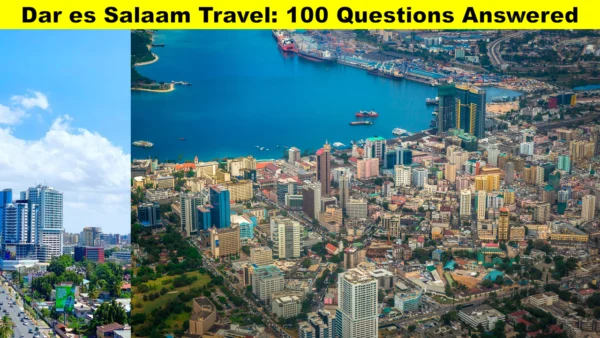
Dar es Salaam Travel: 100 Questions Answered based on NeemTime research
Arrival & Logistics
1. Is the ferry to Zanzibar from Dar es Salaam safe? Yes, but use reputable companies like Azam Marine. Avoid “porters” outside who try to grab your bags; they will expect a tip and can be aggressive.
2. Should I buy ferry tickets in advance? Yes, especially for “Gold Class” or during peak season, as they sell out. You can buy them at the official office near the wharf.
3. Is there a luggage storage facility in Dar? There are no official lockers at the airport or ferry terminal. Some high-end hotels like the New Africa Hotel may hold bags if you eat at their restaurant.
4. How do I get from the airport to the city center? Uber and Bolt are widely used and safer than haggling with random airport taxis.
5. What is the best way to get around the city? Uber and Bolt are best for cars. For shorter, more local trips, use “Bajajis” (tuk-tuks), which can also be ordered via the apps to avoid bargaining.
6. Are “Bodabodas” (motorcycle taxis) safe? Locals use them to beat traffic, but they are high-risk for accidents. Most travelers are advised to stick to Bajajis or cars.
7. Is Dar es Salaam walkable? In specific neighborhoods like Masaki or the CBD (Posta) during the day, yes. However, heat, lack of sidewalks, and traffic make long-distance walking difficult.
8. What is the “Tanzanite Bridge”? A scenic bridge connecting the city center to the Oyster Bay area. It’s great for photos, especially on Saturday mornings when it’s sometimes closed to cars for walkers.
9. How bad is the traffic? It is legendary. A trip that takes 15 minutes at night can take 2 hours during “rush hour” (which seems to be most of the day).
10. Can I use my credit card everywhere? No. While hotels and upscale Masaki restaurants take cards, most of Dar is “cash is king.”
11. Where should I exchange money? Use official bureaus de change in the city center or at Mlimani City Mall. Avoid street changers.
12. Is there a water shortage in Dar? Droughts can occasionally cause water rationing. Better hotels usually have large reserve tanks.
13. Do I need a visa? Most tourists need a visa. The “Visa on Arrival” is available, but the online e-visa is recommended to save time at the airport.
14. Is the airport (JNIA) open 24/7? Yes, it operates around the clock for international flights.
15. Can I get a SIM card at the airport? Yes, providers like Vodacom and Airtel have kiosks at arrivals. You’ll need your passport for registration.
Safety & Etiquette
16. Is Dar es Salaam safe for tourists? Generally yes, but petty crime like bag-snatching is common. Be “street smart”—don’t flash phones or expensive jewelry.
17. Can I walk around at night? It is not recommended, even in “nice” areas. Use an Uber or Bolt for door-to-door transport after dark.
18. What should I wear? Dar is relatively conservative. While Masaki is more relaxed, keep shoulders and knees covered in the city center or Kariakoo to show respect.
19. What is a “Flycatcher”? Touts who follow tourists trying to sell safaris or tours. Be firm but polite; a simple “Hapana asante” (No thank you) usually works.
20. Is it safe for solo female travelers? Yes, but you will receive attention. Avoid walking alone in secluded areas and dress modestly to minimize unwanted comments.
21. Do I need to tip? Tipping is appreciated but not mandatory. In restaurants, 5–10% is standard if service isn’t included.
22. How do I say “Thank you” in Swahili? “Asante.” (Asante sana = Thank you very much).
23. What does “Mambo” mean? It’s a common greeting. The standard reply is “Poa.”
24. Can I drink the tap water? No. Always stick to bottled or filtered water.
25. Is Dar safer than Nairobi or Johannesburg? Most travelers agree that Dar feels significantly safer and more relaxed than those cities, though caution is still required.
Things to Do
26. What is the best beach in Dar? Kigamboni (South Beach) has the cleanest water and best sand.
27. How do I get to Mbudya Island? Take a boat from the Slipway or Kunduchi. It’s a 20-minute ride to a tropical paradise.
28. What’s the difference between Mbudya and Bongoyo? Mbudya is usually busier and better for a “party” or social vibe. Bongoyo is quieter and more rugged.
29. Is Kariakoo Market worth visiting? Yes, for the experience, but it’s chaotic and crowded. Go with a local guide and leave your valuables at the hotel.
30. What is the National Museum of Tanzania? Located in Posta, it houses important fossils from Olduvai Gorge. It’s often described as “underrated.”
31. What is the Village Museum (Makumbusho)? An open-air museum showing traditional Tanzanian huts. They often have traditional dance performances in the afternoons.
32. Where can I buy authentic souvenirs? Mwenge Woodcarvers Market is the go-to spot for carvings and art.
33. Is there a zoo in Dar? Yes, the Dar es Salaam Zoo, but it is quite far from the city center in Kigamboni.
34. Can I go on a safari from Dar? Yes! Mikumi National Park is the closest “real” safari (about a 5–6 hour drive).
35. Is Pugu Hills worth the trip? Yes, for hiking and birdwatching. It’s about 1.5 hours from the city and offers a great view of Dar’s skyline.
36. What is “The Slipway”? A waterfront shopping and dining complex in Masaki. It’s touristy but very safe and has great sunset views.
37. Is the Kivukoni Fish Market worth seeing? Yes, if you go early (6 AM–8 AM). It is intense, smelly, and fascinating.
38. Where is the best place for a sunset drink? The Waterfront or Karambezi Cafe (on the cliffside in Masaki).
39. Can I see wildlife in Dar? Not really, other than monkeys in some gardens. You’ll need to go to Mikumi or Saadani for big game.
40. Are there any art galleries? Nafasi Art Space and the Tingatinga Arts Cooperative are excellent for seeing local contemporary and traditional art.
Food & Drink
41. What is the “must-try” local food? Mishkaki (grilled meat skewers) and Chipsi Mayai (french fry omelet).
42. Where can I get the best street food? Coco Beach in the evening is famous for cassava chips and mishkaki.
43. Is the seafood safe to eat? Yes, provided it’s from a reputable restaurant. Dar has some of the freshest seafood in East Africa.
44. What is “Zanzibar Pizza”? It’s like a stuffed crepe. You can find it at street stalls or in Masaki.
45. Where can I find good Indian food? The city center (Posta) has a high concentration of incredible, authentic vegetarian Indian restaurants.
46. What is the local beer? Kilimanjaro, Safari, and Serengeti are the “big three.”
47. Is there a craft beer scene? It’s growing, but very small. Most people stick to the major lagers.
48. Is coffee good in Dar? Yes! Look for cafes serving Tanzanian beans (from Arusha or Mbeya). “Africafe” is a popular local chain.
49. What is “Ugali”? The national staple—a thick maize porridge eaten with your hands and dipped into stews or beans.
50. Can I find international food? Masaki/Oyster Bay has everything from Italian and Japanese to Thai and Lebanese.
Neighborhoods
51. Where should I stay? Masaki or Oyster Bay for safety and restaurants. Posta for business. Kigamboni for beaches.
52. Is Masaki expensive? Yes, it is the most affluent part of the city. Prices there are comparable to Western cities.
53. What is “Posta”? The Central Business District. It’s busy during the day and very quiet (and slightly eerie) at night.
54. What is “Sinza”? A lively local neighborhood known for its nightlife and local bars.
55. Is Kigamboni far? It’s just across the water. You can take the ferry (cheap but crowded) or drive over the Nyerere Bridge.
56. What is Mlimani City? The biggest modern shopping mall in Dar. It has a cinema, supermarket, and many international brands.
Nightlife
57. Where is the best nightlife? The Masaki area has the most popular clubs like Elements, Havoc, and 1245.
58. Do clubs have cover charges? Some do on weekends, usually around 10,000 to 20,000 TZS.
59. Is it safe to go to local bars? Yes, if you are with a local friend. “Groceries” (local pubs) are great for cheap beer and BBQ.
60. What is a “Jumatano Groove”? A live music event every Wednesday at Alliance Française.
Health & Weather
61. Do I need malaria pills? Consult your doctor. Dar is a malaria zone, and most travelers take prophylaxis.
62. Are there a lot of mosquitoes? Yes, especially at dusk. Use repellent and sleep under a net.
63. When is the rainy season? The “long rains” are from March to May. The “short rains” are in November/December.
64. Is it always hot? Yes. It is humid and tropical year-round. Even the “winter” (June–August) is warm.
65. Should I worry about yellow fever? You need proof of vaccination if you are entering from a country where yellow fever is endemic (like Kenya or Ethiopia).
66. Are hospitals good? Private hospitals like Aga Khan or TMJ are decent for emergencies.
67. Is the sun strong? Extremely. Wear high-SPF sunscreen; you are very close to the equator.
Miscellaneous
68. How do I haggle? Be polite and smile. Start at about 50% of the offered price and meet in the middle. Don’t haggle over small change.
69. Can I take photos of people? Always ask first. Do not take photos of government buildings, bridges, or police/military personnel.
70. What is the internet like? 4G is generally good in the city. Most hotels have Wi-Fi, though it can be spotty.
71. Are there ATMs everywhere? In Masaki and the CBD, yes. In more remote areas, they are harder to find.
72. What power outlet is used? Type G (the British 3-pin plug).
73. Do people speak English? Yes, widely in business and tourism, but Swahili is the heart of the city.
74. Is Dar es Salaam the capital? No, Dodoma is the capital, but Dar remains the commercial and largest city.
75. Can I use USD? In large hotels and for safaris, yes. For everything else, you need Tanzanian Shillings (TZS).
76. Is it okay to eat with my left hand? In traditional settings, use your right hand for eating, as the left is considered “unclean.”
77. How do I cross the street? Wait for a gap and move decisively. Don’t expect cars to stop for you at crosswalks.
78. Are there many stray dogs? Not as many as in other cities, but you will see them. Generally, they leave you alone.
79. Can I buy alcohol easily? Yes, except in some very conservative neighborhoods. Supermarkets and “liquor stores” are common.
80. What should I do if the police stop my Uber? Stay calm. Usually, they are checking the driver’s permits. You don’t need to do anything unless asked.
81. Is there a dress code for the ferry? No, but modesty is respected.
82. Can I fly from Dar to the Serengeti? Yes, there are several “bush flights” daily from the domestic terminal.
83. How long should I spend in Dar? 2–3 days is enough to see the highlights before moving to Zanzibar or a safari.
84. Is the city noisy? Yes. Between the traffic, construction, and call to prayer, it’s a very loud city.
85. What is the most common scam? “Street friends” who walk with you, act helpful, and then demand a large “guide fee.”
86. Can I find a gym? Yes, Masaki has several high-end gyms and CrossFit boxes.
87. Are there public buses? The BRT (blue buses) are great and have their own lanes. The “Daladalas” (minibuses) are crowded and hard to navigate for first-timers.
88. Where can I watch football (soccer)? Benjamin Mkapa Stadium for a live match (the atmosphere is incredible), or any local bar for European leagues.
89. Is it okay to wear a bikini on the beach? On island resorts or hotel beaches, yes. On public beaches like Coco Beach, it’s better to be more covered.
90. What is the “Karibu” spirit? It means “Welcome.” Tanzanians are famously hospitable.
91. Can I buy a SIM card if I’m only there for a day? Yes, but the registration process takes about 15–20 minutes.
92. Is there Uber Eats? Dar has “Piki” and “Yummy,” which are the local versions of food delivery.
93. Can I get a tailored suit? Yes, there are many excellent Indian and local tailors in the city center.
94. What is the best way to get to Bagamoyo? A private taxi or Uber. It’s about 2 hours away and full of history.
95. Is the “Wet n Wild” waterpark good? It’s the largest in East Africa, great for kids, but can feel a bit dated to Western travelers.
96. Can I go scuba diving in Dar? Yes, there are dive centers in Masaki that go to the nearby marine reserves.
97. What is the time zone? East Africa Time (EAT), which is UTC+3.
98. Is Dar es Salaam expensive for a backpacker? It can be, as there aren’t many “hostels,” but local food and transport are very cheap.
99. Should I bring a power bank? Yes, “power cuts” (Luku running out or grid maintenance) can happen.
100. What is the one thing I shouldn’t miss? Taking a late afternoon boat to Mbudya Island for fresh lobster on the beach.