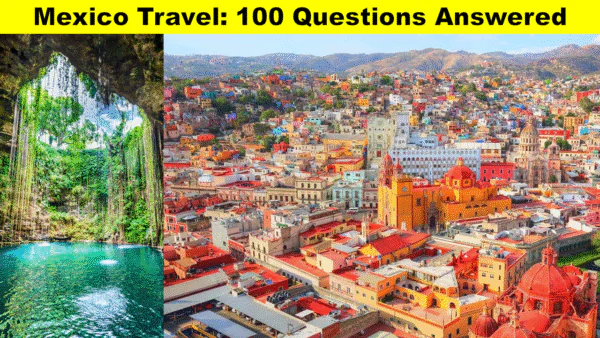
Mexico Travel: 100 Questions Answered based on NeemTime research
✈️ Planning & Logistics
What’s the best time to visit Mexico?
Answer: Generally, November to May for dry weather. Avoid the peak hurricane season (late July to early November) in the Caribbean/Yucatán. April and May can be the hottest months.
Do I need a visa to visit Mexico?
Answer: Citizens of the US, Canada, UK, and many other countries do not need a visa for stays up to 180 days for tourism. You will be issued a tourist card (FMM) upon arrival.
What is the FMM (Forma Migratoria Múltiple)?
Answer: It’s the tourist card/permit you receive upon entry. Keep this safe! You need to surrender it when you leave, and losing it can result in a fine and a trip to an immigration office.
What currency should I use?
Answer: The Mexican Peso (MXN). While US dollars are accepted in major tourist areas like Cancún, you’ll almost always get a better rate paying in pesos.
Where should I exchange currency?
Answer: Avoid airport exchange booths and your hotel. The best rate usually comes from withdrawing pesos directly from an ATM (inside a bank lobby is safest) using a debit card with low or no foreign transaction fees.
Are ATMs safe to use?
Answer: Generally yes, but use ATMs inside a bank lobby or a major supermarket/hotel. Be aware of your surroundings, and look for signs of skimmers (loose card slot). Always decline the ATM’s dynamic currency conversion (DCC).
Should I use cash or credit card?
Answer: Use credit cards for large purchases (hotels, nice restaurants) and cash (pesos) for street food, small shops, tips, and tolls. Use a credit card with no foreign transaction fees.
What are the electrical outlets like?
Answer: They are the same as the US/Canada (Type A and B, two flat prongs or two flat prongs with a round ground pin, 127V). Visitors from other regions will need an adapter.
Do I need a local SIM card?
Answer: It’s highly recommended for using navigation/Uber and making reservations. Telcel is the largest and most reliable network. You can often buy a SIM at the airport or an OXXO (convenience store).
How long should I spend in Mexico City?
Answer: Most travelers recommend at least 4 to 7 days to cover the major sites, museums, and neighborhoods like Roma and Condesa, plus a day trip (e.g., to Teotihuacán or Puebla).
Should I rent a car?
Answer: Only recommended for specific road trips (e.g., the Yucatán Peninsula or Baja). Driving in major cities like CDMX or Guadalajara is difficult due to traffic, confusing signs, and aggressive drivers. Intercity buses are excellent.
Are Mexican intercity buses reliable?
Answer: Yes, very reliable and comfortable. The first-class buses (like ADO) are a great way to travel between cities.
Is it better to fly or take a bus for long distances?
Answer: For very long distances (e.g., Cancún to Mexico City), flying with a budget airline like Volaris or Viva Aerobus is faster, but be prepared for potential delays and strict baggage rules. For medium distances, a first-class bus is often comparable in time and more comfortable.
What is tipping etiquette?
Answer: Tipping is customary. 10-15% is standard for restaurant service; 15-20% for excellent service. Tip luggage handlers, housekeepers (20-50 pesos per night), and tour guides. Round up taxi/Uber fares.
What Spanish phrases should I learn?
Answer: Hola, Gracias, Por favor, ¿Habla inglés?, La cuenta, por favor (The check, please), ¿Cuánto cuesta? (How much does it cost?), Una cerveza, por favor. Effort is appreciated.
🛡️ Safety & Health
Is Mexico safe for tourists?
Answer: Yes, the vast majority of tourists visit without incident. Safety varies greatly by location. Major tourist zones (Riviera Maya, Puerto Vallarta, CDMX’s central neighborhoods) are heavily secured.
What areas should I avoid in Mexico City?
Answer: Neighborhoods like Tepito and Doctores should be avoided, especially at night, unless you are with a local guide. Stick to well-traveled areas like Roma Norte, Condesa, Coyoacán, and Polanco.
How can I stay safe regarding crime?
Answer: Don’t flash expensive jewelry or electronics. Use official transportation (hotel transport, authorized airport taxis, or Uber/DiDi). Be aware of your surroundings, especially at night. Never buy drugs.
Will I encounter cartels?
Answer: No, cartel activity is overwhelmingly among themselves and generally does not target tourists, especially in tourist zones. The best way to stay safe is to avoid involvement in illegal activities.
Is the tap water safe to drink?
Answer: No, do not drink the tap water. Use bottled water for drinking.
Is the ice in drinks safe?
Answer: Yes, the ice is safe in all reputable hotels, resorts, and restaurants. They use purified water (often distinguishable by the cylindrical shape with a hole in the middle).
Can I eat street food safely?
Answer: Yes, and you should! To minimize risk, choose popular stalls with a long line of locals and high turnover. Hot, freshly cooked food is best.
How do I avoid getting Montezuma’s Revenge (traveler’s diarrhea)?
Answer: Follow the water rule, wash hands frequently, and ease into new foods/spices. Bring Imodium or Pepto-Bismol, and consider a probiotic before/during the trip.
Should I worry about police corruption?
Answer: While rare for tourists, some may try to ask for a “fine” for a minor or fabricated infraction. Remain polite, ask for the ticket in writing, and firmly state you will pay at the police station. Do not pay a bribe (mordida) if you can avoid it.
Do I need travel insurance?
Answer: Highly recommended. Your home country’s health insurance is unlikely to cover international medical emergencies or evacuations, which can be very expensive.
Should I use Uber/DiDi or a taxi?
Answer: Uber/DiDi is usually preferred in cities where they operate (like CDMX) as the fare is set and trackable. In areas without ride-share, use sitio (authorized) taxis or arrange transport through your hotel.
Are there any scams I should know about?
Answer: ATM card skimming (use bank ATMs), “fake” police/officials, and aggressive timeshare salesmen (especially in the Riviera Maya/Cancún airport). Ignore all unsolicited offers at the airport.
Is it safe to travel alone as a woman?
Answer: Many women travel solo without issue. Stick to well-known areas, avoid walking alone at night, be mindful of your drinks, and trust your gut.
Do I need bug spray?
Answer: Yes, especially in coastal and jungle areas (Yucatán, Chiapas). Look for repellents with high DEET content.
What is the altitude in Mexico City and how can I manage it?
Answer: CDMX is very high (over 7,300 ft/2,240m). To manage altitude sickness, drink plenty of water, avoid alcohol on arrival, and take it easy for the first 24 hours.
🗺️ Destinations & Sightseeing
What is the difference between Riviera Maya and Puerto Vallarta?
Answer: Riviera Maya (East/Caribbean coast): White sand beaches, turquoise water, close to Mayan ruins (Chichén Itzá, Tulum, Cobá), cenotes, and all-inclusive resorts. Puerto Vallarta (West/Pacific coast): Golden beaches, mountains, a more authentic Mexican town feel (Old Town/Zona Romantica), great food, and known for whale watching (winter).
Where are the best cenotes?
Answer: In the Yucatán Peninsula. Popular ones include Cenote Suytun, Gran Cenote, and those near Valladolid (like Zací). Many smaller, less crowded ones exist outside the major tourist hubs.
Should I visit Tulum or Playa del Carmen?
Answer: Tulum: Known for its iconic ruins, trendy beach clubs, and “boho-chic” (and expensive) vibe. Playa del Carmen: More developed, great walkable core (5th Avenue), and a good base for day trips.
What is the best major Mayan ruin to visit?
Answer: Chichén Itzá is the most famous and UNESCO World Heritage Site. Palenque (Chiapas) is highly praised for its jungle setting. Uxmal (Yucatán) is less crowded and architecturally stunning.
What are the must-see museums in Mexico City?
Answer: Museo Nacional de Antropología (essential), Frida Kahlo Museum (Casa Azul—book tickets weeks in advance!), and Palacio de Bellas Artes.
Where is the best place for a foodie trip?
Answer: Oaxaca City is considered the culinary capital, famous for mole, tlayudas, and mezcal. Also, Mexico City has world-class street food and fine dining.
Is Guanajuato City worth visiting?
Answer: Absolutely. It’s a beautiful, colorful, colonial-era city with a unique system of underground tunnels, great for a few days.
Where can I go for authentic Mexican culture, away from resorts?
Answer: Oaxaca, Mérida, San Cristóbal de las Casas, and Guanajuato are often recommended for their strong local culture, history, and fewer crowds of all-inclusive tourists.
What’s the best beach town for a relaxed, non-party vibe?
Answer: Isla Holbox (Yucatán Peninsula), Bacalar (Lagoon of Seven Colors), or towns on the Oaxacan coast (Mazunte, San Agustinillo, or Puerto Escondido for surfing).
Are the Teotihuacán pyramids climbable?
Answer: As of recent years, access to climb the Pyramids of the Sun and Moon has been restricted by INAH (National Institute of Anthropology and History). You can still walk around the complex.
🍽️ Food & Drink
What is mole?
Answer: A complex sauce, often with dozens of ingredients (including different chiles, spices, seeds, and sometimes chocolate). It’s a culinary highlight, particularly in Oaxaca and Puebla.
Are there different types of tacos?
Answer: Yes, there are hundreds! Common types include al pastor (pork cooked on a vertical spit), suadero (beef), carnitas (braised pork), and barbacoa (slow-cooked meat).
What is mezcal?
Answer: An alcoholic spirit distilled from any type of agave plant (tequila is only made from blue agave). It’s typically smoky and artisanal, with Oaxaca being its heartland.
Should I drink tequila or mezcal?
Answer: Try both! Tequila is great in cocktails (Margarita) or shots, while mezcal is usually savored neat (a besitos—in small kisses) to appreciate its complex flavor.
What is a tlayuda?
Answer: A very large, thin, crunchy Oaxacan tortilla covered with bean paste, pork lard, cheese, and various toppings. It’s often called a “Mexican pizza.”
How spicy is the food?
Answer: It varies. Many main dishes are flavorful but not overly spicy. Salsa is where the heat is! The green sauce is often hotter than the red, but always ask before dousing your food.
What is agua fresca?
Answer: Light, non-alcoholic drinks made from water blended with fruits (like watermelon, hibiscus, or tamarind), seeds, or rice (horchata). They are delicious and refreshing.
Should I avoid salads/raw vegetables?
Answer: In reputable, busy, and modern restaurants/hotels, salads are generally safe as they use purified water to wash produce. If you have a sensitive stomach, stick to cooked foods and peeled fruits.
What is the difference between a torta and a cemita?
Answer: A torta is a sandwich served on a soft French-style roll (telera), popular everywhere. A cemita is a specialty of Puebla, served on a sesame seed bun and traditionally stuffed with ingredients like milanesa (breaded meat) and quesillo (string cheese).
Do most restaurants accept credit cards?
Answer: High-end restaurants and those in tourist zones usually do. Street food and smaller, family-run restaurants (fonda or cocina económica) are cash-only. Always have some pesos on hand.
🏛️ Culture & Etiquette
Is it offensive if I don’t speak Spanish?
Answer: No, but locals deeply appreciate the effort. Learn a few key phrases, use a translation app, and speak slowly. Patience is key.
Should I be on time for everything?
Answer: Punctuality is appreciated for tours and formal appointments, but Mexico often operates on “Mexican time,” meaning a more relaxed schedule. Don’t be surprised if people/tours are a little late.
How should I greet people?
Answer: A handshake is common for new acquaintances. Friends often use a light one-cheek kiss (usually right cheek to right cheek) and a brief hug.
What should I wear when visiting a church or cathedral?
Answer: Dress modestly. This means covering your shoulders, and for women, avoiding mini skirts or short shorts. Men should generally wear long pants.
Is haggling acceptable at markets?
Answer: Yes, it is expected at open-air markets (mercados) for souvenirs and non-food items, but be respectful and don’t lowball. Prices for food and in formal stores are usually fixed.
What is Día de Muertos (Day of the Dead)?
Answer: A festive and colorful tradition (Oct 31-Nov 2) where families honor and remember deceased loved ones. It is not Halloween. Oaxaca and Michoacán are famous for their observances.
Is it appropriate to take photos of locals?
Answer: Always ask for permission first, especially if the person is older, working, or in traditional dress. Some people may expect a small tip in exchange.
What should I say if someone sneezes?
Answer: Say “Salud” (Health), which is the Spanish equivalent of “Bless you.”
Is it common to eat dinner late?
Answer: Yes, dinner is usually eaten quite late, often after 8 or 9 PM. Restaurants may not even open for dinner until 7 PM. Many people have a heavy meal (lunch, comida) between 2 and 4 PM.
What are cocina económicas?
Answer: Small, family-run restaurants that offer a fixed-price, multi-course lunch (menú del día or comida corrida) that is excellent value and authentic.
📱 Tech & Connectivity
Will my cell phone work in Mexico?
Answer: Most major US/Canadian carriers offer international plans or daily passes. If your phone is unlocked, a local SIM (Telcel) is usually the cheapest option.
Is Wi-Fi widely available?
Answer: Yes, most hotels, cafés, restaurants, and airports offer free Wi-Fi. Connection speed is generally good in major cities.
Can I rely on Google Maps or Citymapper in Mexico City?
Answer: Yes, absolutely. Google Maps is great for navigation, and Citymapper is often recommended by locals as the best app for navigating CDMX’s public transport (Metro, Metrobus).
Should I download any apps before I go?
Answer: Google Translate (with offline Spanish downloaded), Uber/DiDi (for cities), and your airline’s app.
Is it safe to use public charging stations?
Answer: Be cautious. There have been reports of “juice jacking” (data theft). It’s safer to use your own adapter and power bank.
🏖️ Coast & Beach
Are the beaches on the Pacific side safe for swimming?
Answer: Not all of them. The Pacific surf can be very strong. Always check local flags and warnings. Many resorts have swimmable coves.
Where can I see bioluminescence?
Answer: La Ventanilla and Manialtepec Lagoon (near Puerto Escondido) on the Pacific coast, and Holbox Island or Xpu-Ha (Yucatán) on the Caribbean side. Best seen during the new moon.
When is whale watching season in Puerto Vallarta/Baja?
Answer: Late November/early December through March, with peak sightings in January and February. Humpback whales migrate here to calve.
Is there sargassum (seaweed) on the Caribbean coast?
Answer: Yes, it is a recurring issue, especially between April and August. The amount varies daily. Isla Mujeres, Cozumel, and Holbox often have less due to their location.
What are balnearios?
Answer: Inland, spring-fed water parks or natural swimming holes, often with thermal waters, popular with Mexican families. A great alternative to the beach.
🏞️ Inland & Central Mexico
Should I go to Puebla?
Answer: Yes, it’s a beautiful, historic colonial city famous for its Talavera ceramics, incredible food (like chiles en nogada), and proximity to the giant pyramid of Cholula.
How do I get to Teotihuacán from Mexico City?
Answer: Take the Metro to the North Bus Terminal (Autobuses del Norte), then a direct bus from there. It’s affordable and takes about an hour.
Is it worth visiting San Miguel de Allende?
Answer: Yes, it’s a stunning, very well-preserved colonial city with a strong expat/artistic community. It’s known for its architecture, galleries, and sophisticated dining.
What is special about Oaxaca City?
Answer: It’s a UNESCO World Heritage site known for its deep indigenous roots, incredible gastronomy, mezcal production, colorful textiles, and nearby ancient ruins (Monte Albán).
What is the Metro in Mexico City like?
Answer: It’s fast, efficient, and extremely cheap, but it can be very crowded, especially during rush hour. There are women-only carriages on some lines during peak hours.
🛂 Customs & Departure
Do I need to declare prescription medication?
Answer: Yes, bring medication in its original container with the prescription label, and carry a copy of the prescription.
What is the limit for bringing alcohol/tobacco back home?
Answer: Check your home country’s customs regulations. For US/Canada, it’s typically one liter of alcohol and a set number of cigarettes/cigars.
What is the procedure for domestic flights in Mexico?
Answer: Be prepared for budget airlines (Volaris, Viva Aerobus) to be very strict about baggage weight and size. Check in early and pay attention to their rules to avoid last-minute fees.
What if I lose my FMM tourist card?
Answer: You must report it to an immigration office (INM) before departure to pay a fine and get a replacement card to exit the country.
How early should I arrive for my international flight?
Answer: 3 hours before departure is generally recommended, as check-in lines and security can be long, especially at Cancún (CUN) or Mexico City (AICM).
📝 Miscellaneous Rapid Fire
What is chiles en nogada? A seasonal dish (late summer/fall) from Puebla: poblano chile stuffed with meat/fruit, covered in a creamy walnut sauce (the nogada), and topped with pomegranate seeds and parsley (representing the Mexican flag colors).
What language should I expect in Quintana Roo (Cancún/Playa)? English is widely spoken in tourist zones, but Spanish is the language of communication with locals.
What is the “pink taxi” I see in CDMX? It’s often DiDi, a popular ride-sharing service, or sometimes traditional taxis painted pink.
What is the best way to get from Cancun Airport (CUN) to Playa del Carmen? Pre-booked private transport, shared shuttle, or the ADO bus. Ignore all airport solicitors.
What is the best way to see the Monarch Butterfly Biosphere Reserve? Visit from November to March/April, and hire a local guide near Angangueo or El Rosario.
Is it necessary to have Mexican auto insurance if I rent a car? Yes, Mexico requires third-party liability insurance, and foreign policies are often not sufficient.
What is the Zócalo? The main square in the center of a city (especially Mexico City), typically surrounded by the cathedral and government buildings.
What is a tianguis? A traditional, open-air, temporary market, often held one day a week in a neighborhood, selling everything from food to electronics.
Are all the beaches open to the public? Legally, all beaches are public property, though access points are sometimes difficult due to hotels.
What is horchata made of? A sweet, milky drink made from rice, cinnamon, and vanilla.
Can I use my credit card for Uber? Yes, linking your card to the app is convenient and safer than using cash.
Where can I see Lucha Libre? Most famously in Mexico City at Arena México, on Tuesday, Friday, and Sunday nights.
What’s a good alternative to Chichén Itzá? Uxmal or Ek’ Balam (Yucatán) are both stunning and less crowded.
Should I learn about the history before going? Highly recommended! A basic understanding of Mayan, Aztec, and Colonial history will enhance your visits to ruins and museums.
What is Chiapas known for? Its indigenous culture, stunning nature (Sumidero Canyon), and lush jungle ruins (Palenque).
Is it safe to get a tattoo or piercing in Mexico? Use the same caution as home: research the shop, check hygiene, and ensure they use sterilized equipment.
Can I use my US/Canadian driver’s license? Yes, it is typically valid for driving for tourists.
Is it easy to find vegetarian/vegan food? Increasingly so, especially in major cities and tourist zones. Many traditional dishes (like tlayudas or bean tacos) can be made meat-free.
What’s the best souvenir to bring home? Ceramics (Talavera from Puebla, black pottery from Oaxaca), textiles, mezcal, vanilla, and fine silver jewelry (especially from Taxco).
How can I avoid getting burned by the sun? The Mexican sun is intense! Wear high-SPF sunscreen (preferably reef-safe in coastal areas), a wide-brimmed hat, and sunglasses.