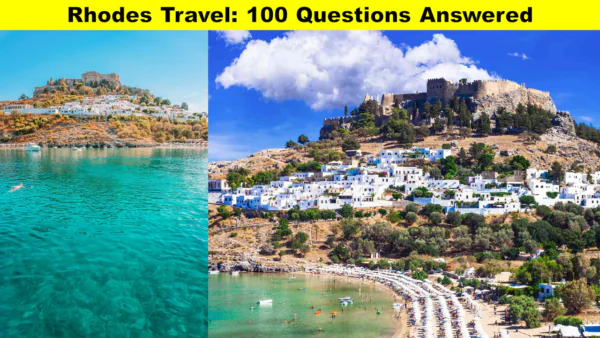
Rhodes Travel: 100 Questions Answered based on NeemTime research
Getting Around & Logistics
Is a car necessary? Yes, Rhodes is large. While buses exist, a car is highly recommended for exploring beyond the main towns.
Are quads safe? Most locals and frequent travelers advise against them; they are prone to accidents on uneven Greek roads.
Is public transport reliable? It’s okay between major hubs like Rhodes Town and Faliraki, but often crowded and infrequent for remote beaches.
Do taxis take cards? Some do, but many still prefer cash. Always ask before getting in.
Is there Uber? No, but the “Uber” app can sometimes be used to hail local taxis in specific areas.
How is the driving? It can be “creative.” Expect some tailgating and ignored stop signs; stay alert.
Is parking free? Usually yes, except in the heart of Rhodes Town and Lindos where you must use designated paid lots.
Can I rent a boat without a license? Yes, small motorboats (usually up to 30hp) can be rented for the day without a permit.
How far is the airport from the Old Town? About 20–30 minutes by taxi or bus.
Are there ferries to other islands? Yes, frequent daily ferries go to Symi, Chalki, and Kos.
Is the island walkable? Only within specific towns like the Old Town or Lindos; otherwise, distances are too great.
What side of the road do they drive on? The right side.
Are road signs in English? Most major signs are in both Greek and English.
Is petrol expensive? Yes, typically higher than in the US or UK.
Can I use a digital driver’s license? Better to carry your physical card and an International Driving Permit if you are from outside the EU.
Where to Stay
Where is best for nightlife? Faliraki is the party hub.
Where is best for families? Kolymbia and Stegna are quieter with great family resorts.
Is the Old Town good for staying? It’s magical and atmospheric, but can be noisy and difficult to access with luggage.
What’s the “calm” side of the island? The East Coast (Lindos, Faliraki) has calmer waters; the West Coast (Ixia, Ialyssos) is windier.
Is Lindos too touristy to stay in? It’s very busy during the day but incredibly peaceful and romantic at night.
Where should I stay without a car? Rhodes Town or Faliraki offer the best transport links.
Are there all-inclusive resorts? Plenty, especially in the Kiotari and Mitsis areas.
Is the South of the island inhabited? It’s much more rural and quiet, ideal for those wanting to escape crowds.
Are hotels cheaper in the North? Often, because the North/West coast is windier and has pebble beaches.
Is Ixia good for swimming? It’s wavy and pebbly; better for windsurfing than casual swimming.
Food & Dining
Is the food expensive? Expect to pay €15–€25 for a standard meal. Old Town and Lindos prices are higher.
Are there tourist traps? Yes, avoid places in the Old Town where “touts” try to pull you in from the street.
What is a must-try dish? Pitaroudia (chickpea fritters) and fresh grilled octopus.
Can I drink tap water? It’s safe in most areas but tastes heavily of minerals. Most travelers stick to bottled water.
Is tipping expected? It’s not mandatory, but rounding up the bill or leaving 5–10% is appreciated.
What time do Greeks eat dinner? Late. Restaurants start filling up after 9:00 PM.
Are there vegetarian options? Yes, Greek cuisine has many “orphan” dishes (meat-free) like Gemista or Briam.
Where can I find the best seafood? Stegna and the small village of Haraki are famous for fresh fish.
Is gyro the cheapest meal? Yes, a gyro pita is usually €4–€6 and very filling.
Do I need to book restaurants? For popular spots in Lindos or the Old Town in July/August, yes.
Are supermarkets well-stocked? Yes, large ones like AB or Sklavenitis have everything you need.
Can I find craft beer? Look for “VAP” (local) or “Magnus Magister” brewed on the island.
What is Souma? A local spirit similar to Raki or Grappa; it’s very strong!
Are there any “hidden gem” restaurants? Many travelers recommend the mountain village of Embonas for meat lovers.
Is coffee culture big? Huge. Try a Freddo Espresso or Freddo Cappuccino.
Sights & Activities
Is the Palace of the Grand Master worth it? Absolutely, it’s one of the best-preserved medieval buildings in Europe.
What is the “must-see” beach? St. Paul’s Bay in Lindos and Anthony Quinn Bay.
Is the Valley of the Butterflies worth it? Only from June to August when the moths are actually there; otherwise, it’s just a nice walk.
What is Seven Springs? A wooded area with a dark tunnel you can walk through in water; great for cooling off.
Is the Colossus of Rhodes still there? No, it was destroyed by an earthquake in 226 BC.
Can I visit the Acropolis of Rhodes? Yes, it’s a short distance from the city center and free to enter.
What is Prasonisi? The southern tip where the Aegean and Mediterranean seas meet; popular for kitesurfing.
Is Symi a good day trip? Highly recommended. It’s a 1-hour ferry ride to one of the most beautiful harbors in Greece.
Are there any castles to visit? Monolithos Castle offers the best sunset views on the island.
Can I go scuba diving? Yes, Kalithea Springs is the primary spot for diving.
Is the Water Park in Faliraki good? It’s one of the largest in Europe and very popular with families.
What is the Street of the Knights? A famous medieval street in the Old Town where the different “tongues” of knights lived.
Are there many cats? Yes, hundreds. Most are friendly and looked after by locals.
Can I see Turkey from Rhodes? Yes, the Turkish coast is clearly visible from the north side of the island.
Is there a toy museum? Yes, a quirky one in Archipoli that travelers often find surprisingly fun.
Beaches
Are the beaches sandy? Most on the East are sandy (Tsambika is the best), while the West is mostly pebbles.
Do I have to pay for sunbeds? Usually yes, prices range from €10 to €30 for a set of two.
Is Anthony Quinn Bay crowded? Extremely. Go before 9:00 AM to get a spot.
Which beach is best for snorkeling? Anthony Quinn and Ladiko Bay.
Is nudism allowed? There is an official nudist beach just south of Faliraki.
Are there jellyfish? Rarely, but they can occasionally appear depending on currents.
Is the water warm? By July/August, it’s like “bath water.”
Are there sea urchins? Yes, on rocky beaches. Wear water shoes.
Can I find “wild” beaches? Yes, the further south you drive, the emptier the beaches get.
Is Elli Beach good? It’s right in the city, so it’s convenient but very busy. It has a famous diving platform.
Weather & Timing
When is the best time to visit? May, June, or September. July and August are scorching.
How hot does it get? Temperatures often exceed 35°C (95°F) in mid-summer.
Does it rain in summer? Almost never.
Is Rhodes open in winter? Most tourist shops and resorts close from November to March, but the main city remains active.
Is it windy? The West Coast is very windy, which is great for heat relief but makes the sea choppy.
When do the butterflies arrive? Usually by mid-June.
Is it humid? It can be, especially in August.
Is the Meltemi wind a factor? Yes, it blows strongly in July and August.
Culture & Customs
Do I need to speak Greek? No, almost everyone in tourism speaks excellent English.
Is “Opa!” common? It’s mostly for tourists. Don’t expect people to break plates at dinner.
What should I wear to churches? Shoulders and knees should be covered.
Are the locals friendly? Generally very hospitable (Philoxenia).
Can I flush toilet paper? Usually no. Most Greek plumbing requires you to put it in the bin provided.
Is Rhodes safe? Very. Violent crime is extremely rare.
What is the currency? Euro (€).
Are shops closed on Sundays? In tourist areas, no. In local villages, many will be.
Shopping & Budget
What should I buy? Local honey, olive oil, leather sandals, and ceramic pomegranate decorations.
Is Rhodes a “premium” destination? It’s more expensive than the mainland but cheaper than Santorini or Mykonos.
Are there big malls? No, shopping is mostly small boutiques and high-street shops in the New Town.
Can I haggle? Not in standard shops, but you might get a small discount at markets or for long-term car rentals.
Is there a duty-free? Yes, at the airport.
How much is a beer? In a tavern, €4–€6; in a supermarket, €1.50.
Are pharmacies common? Yes, look for the green cross. They are very helpful.
Do I need cash for the bus? You can buy tickets at kiosks or use a card on some newer buses.
General Advice
Is Rhodes better than Crete? Rhodes is more compact and easier to see in a week; Crete is massive and needs more time.
What’s a common scam? “Flower girls” or people offering “free” bracelets in the Old Town who then demand money.
Are there mosquitoes? Yes, bring repellent for the evenings.
Is the airport busy? Yes, it’s the 4th busiest in Greece. Give yourself plenty of time for departures.
Can I visit Chalki? Yes, a beautiful quiet island nearby, perfect for a peaceful day trip.
Are there many hills? The Old Town is flat, but Lindos and many mountain villages involve steep climbs.
Is it good for solo travelers? Very safe and social, especially in Rhodes Town hostels.
Can I see the sunrise? Yes, the East Coast (Faliraki/Lindos) has spectacular sunrises.
Where is the best sunset? Monolithos or Kritinia Castle.
Is there a big “British” influence? Yes, especially in Faliraki and Pefkos.
Will I regret going? Almost certainly not; most visitors end up returning.