Iran Travel: 100 Questions Answered based on NeemTime research
🛂 Visas & Entry
1. Can Americans, Brits, and Canadians visit? Yes, but you cannot travel independently; you must be part of a licensed tour or have a private guide.
2. Do I need a visa? Most nationalities do, but as of 2025, many countries (including many in the EU, UAE, and others) have visa-free entry for short stays. Check the latest e-visa portal.
3. Does an Iranian stamp in my passport affect US travel? Iran usually does not stamp passports anymore (they provide a separate paper) to help travelers avoid issues with the US Visa Waiver Program (ESTA).
4. How long does the e-visa process take? Usually 5–10 business days, though it can vary by nationality.
5. Is there a “Visa on Arrival” (VOA)? Yes, for many nationalities at major airports like IKA, but it is often recommended to apply for a grant notice online first.
6. Can I visit Kish Island without a visa? Yes, Kish and Qeshm islands are free-trade zones where most nationalities can enter for 14 days without a visa.
7. Can I enter Iran if I have an Israeli stamp? Usually, no. If you have evidence of visiting Israel in the last 1–2 years, you may be denied entry.
8. Do I need travel insurance? Yes, it is mandatory. It must specifically state “Iran” on the policy; general “Worldwide” policies often exclude it.
9. Can I buy insurance at the airport? Yes, there is a counter at IKA airport, but it’s often cheaper to buy online in advance.
10. What is a “Visa Grant Notice”? It is the document you receive after your online application is approved, which you take to the embassy or airport to get your visa.
💰 Money & Costs
11. Do international credit cards work? No. Due to sanctions, Visa, Mastercard, and Amex do not work. You must bring all your money in cash.
12. Which currency should I bring? US Dollars or Euros are the most widely accepted and easiest to exchange.
13. What is the difference between Rial and Toman? 1 Toman = 10 Rials. Most people talk in Toman. If someone says “50,” they usually mean 50,000 Toman.
14. Where should I exchange money? Use “Sarrafi” (official exchange offices) in cities for the best rates. Avoid the official bank rate, as the open market rate is much higher.
15. Is there an Iranian debit card for tourists? Yes, services like Mahcard or Daric allow you to deposit cash and use a local debit card.
16. Is Iran expensive? For those with USD or EUR, Iran is very affordable. A high-end meal often costs less than $10–15.
17. Do I need to tip? Tipping (Chay-pooli) is appreciated but not mandatory. In upscale restaurants, 10% is standard.
18. What is Taarof? A complex system of etiquette where people may offer things for free (like a taxi ride). You should politely decline three times before accepting or insisting on paying.
19. How much cash should I bring for 2 weeks? Budgeting $50–$80 per day is usually more than enough for a mid-range experience, including domestic travel and shopping.
20. Can I use ATMs? Only with a local Iranian bank card. International cards will not work.
👗 Dress Code & Conduct
21. What is the dress code for women? Hair must be covered with a headscarf (hijab), and the body should be covered with loose clothing (manteau) that reaches mid-thigh.
22. Do I have to wear a Chador? No, only in certain holy shrines (which usually provide them for free at the entrance).
23. Can I wear sandals? Yes, both men and women can wear sandals.
24. What is the dress code for men? No shorts in public. T-shirts and jeans are perfectly fine.
25. Can I show some hair? In cities like Tehran or Shiraz, many women wear scarves loosely. However, always have it ready to pull forward if needed.
26. Is makeup okay? Yes, Iranian women are famous for their elaborate makeup and fashion.
27. Is alcohol legal? No, alcohol is strictly prohibited in Iran.
28. Can I take photos of government buildings? Absolutely not. Avoid photographing anything with a “no photography” sign, military sites, or police.
29. Is it okay to hold hands with my partner? Modest public displays of affection (holding hands) are generally tolerated for tourists, but kissing in public is a no-go.
30. How should I greet the opposite sex? A nod and a smile are best. Do not offer a handshake unless they initiate it.
📱 Tech & Internet
31. Is the internet censored? Yes, Facebook, X (Twitter), YouTube, and many news sites are blocked.
32. Do I need a VPN? Yes, a VPN is essential. Download 2 or 3 different ones before you arrive.
33. Does WhatsApp and Instagram work? They are frequently restricted; you will likely need a VPN to use them reliably.
34. Can I buy a local SIM card? Yes, Irancell or Hamrah-e-Aval are common. You can buy them at the airport with your passport.
35. Is there public Wi-Fi? It exists in hotels and some cafes, but it is often slow. A local SIM with data is better.
36. Which maps app works best? Google Maps works, but “Neshan” or “Balad” are local apps that are more accurate for Iranian traffic and routing.
37. Is there a ride-sharing app? Yes, Snapp is the Iranian version of Uber. It is very cheap and highly recommended.
38. Can I use my phone’s roaming? Rarely. Most western carriers do not have roaming agreements with Iran.
39. Do I need a power adapter? Iran uses Type C and F (standard European two-round-pin plugs). The voltage is 220V.
40. Are there “Internet Cafes”? They are becoming rare as everyone uses mobile data, but they can still be found in major cities (Coffee Nets).
🚗 Transportation
41. Is it safe to drive in Iran? Traffic is chaotic. It is generally recommended to use taxis, Snapp, or hire a driver rather than driving yourself.
42. How are the domestic flights? Cheap and frequent between major cities, but you usually need a local agency or a “Fixer” to book them as they aren’t on Expedia.
43. Is the train system good? Yes, the trains (especially the 4-star and 5-star Fadak trains) are excellent, clean, and very affordable.
44. What are “VIP Buses”? These are long-distance buses with only 25 seats (very spacious). They are the best way to travel between cities like Tehran, Isfahan, and Shiraz.
45. How do I get from IKA Airport to Tehran? The best way is by Snapp or a pre-booked airport taxi (about an hour drive).
46. Is there a Metro in Tehran? Yes, it is very efficient, clean, and cheap. There are women-only carriages at the ends of the trains.
47. Can I walk everywhere? Major cities are walkable in the centers, but Tehran is massive—you will need the Metro or taxis.
48. Are taxis metered? Usually no. Agree on a price before getting in, or use Snapp to get a fixed price.
49. What are “Savari” taxis? Shared taxis that run fixed routes between or within cities. You pay for one seat.
50. Can I rent a car? Possible, but rare for tourists. Most hire a “car with driver” which acts as a guide/translator.
🏨 Accommodation
51. Can I book hotels on Booking.com? No. You must use Iranian booking sites (like 1stQuest or TapPersia) or email/WhatsApp the hotels directly.
52. What are “Traditional Hotels”? Beautifully restored historic houses, especially in Kashan, Yazd, and Isfahan. They are highly recommended over modern hotels.
53. Is Couchsurfing legal? Technically no, but it is very active. Be aware of the risks as a foreigner.
54. Do hotels need my passport? Yes, they will hold your passport at the front desk for the duration of your stay. This is standard procedure.
55. Is there a “marriage certificate” requirement for couples? For foreign tourists, hotels almost never ask for proof of marriage.
56. Are hostels available? Yes, there is a growing hostel scene in Tehran, Isfahan, Shiraz, and Yazd catering to backpackers.
57. Is it safe to stay in local homes? Iranians are incredibly hospitable and will often invite you to stay. While generally safe, use your best judgment.
58. Do hotels have Western toilets? Most hotels (3-star and up) have Western toilets, but smaller guesthouses may only have “squat” toilets.
59. What is a “Hammam”? A traditional bathhouse. Some are now museums, while others are still in use as spas.
60. Should I book in advance? During peak seasons (Spring and Autumn), yes. During off-peak, you can usually find rooms on the go.
🍽️ Food & Drink
61. What is the must-try dish? Ghormeh Sabzi (herb stew) and Fesenjan (pomegranate walnut stew).
62. Is the tap water safe to drink? In most major cities, yes, but most tourists stick to bottled water which is very cheap.
63. What is “Dugh”? A popular savory yogurt drink with mint and salt. It’s an acquired taste!
64. Are there vegetarian options? Iranian food is meat-heavy, but dishes like Mirza Ghasemi (eggplant) and Kashke Bademjan are great vegetarian choices.
65. Is street food safe? Generally yes, especially if it’s cooked hot. Ash (thick soup) sold on the street is a favorite.
66. What time is dinner? Iranians eat late. Restaurants are usually busy from 8:30 PM to 11:00 PM.
67. Is there coffee in Iran? Tea is king, but there is a massive “Third Wave” coffee culture in Tehran and Isfahan with excellent cafes.
68. What are the best snacks? Saffron ice cream (Bastani) and Faloodeh (frozen starch noodles with rose water).
69. Can I find international food? Yes, Tehran has everything from Italian to Sushi, though “Persian Pizza” is its own unique thing.
70. What is “Digzi” or “Abgoosht”? A traditional lamb and chickpea stew served in a stone pot that you mash yourself. It’s a full experience!
🏛️ Sightseeing & Culture
71. What is the “Golden Triangle”? The route between Isfahan, Shiraz, and Yazd, which covers the most famous historical sites.
72. When is the best time to visit? Spring (March–May) and Autumn (September–November).
73. What is Nowruz? The Persian New Year (around March 21). It’s a festive time, but travel is difficult as everything is booked and prices rise.
74. Are museums closed on certain days? Many museums are closed on Mondays or during specific religious mourning days.
75. What is Persepolis? The ceremonial capital of the Achaemenid Empire, located about an hour from Shiraz. It is a must-see.
76. Can I visit mosques as a non-Muslim? Yes, most mosques are open to tourists. You just need to dress modestly and remove your shoes.
77. What is a “Bazaar”? The traditional marketplace. The Grand Bazaar in Tehran and the Tabriz Bazaar (UNESCO site) are the most famous.
78. Is Iran safe for solo female travelers? Many travelers report feeling safer in Iran than in Western Europe, but you will receive a lot of attention (mostly curious and helpful).
79. What should I buy as a souvenir? Saffron, carpets, turquoise jewelry, and Termeh (hand-woven cloth).
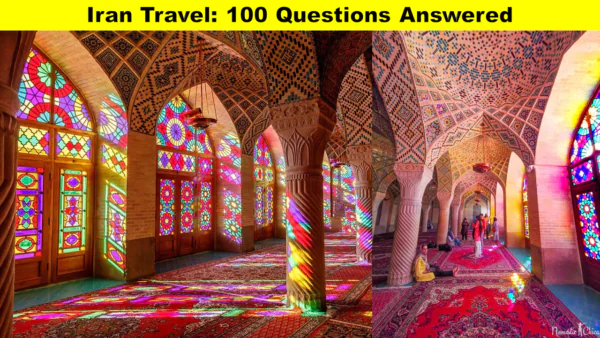
80. What is the “Pink Mosque”? Nasir al-Mulk Mosque in Shiraz, famous for its stained glass windows that create a light show in the morning.
🚩 Safety & Concerns
81. Is it safe to visit right now? Safety varies. Check your government’s travel advisory. While the “street safety” is high, the “political safety” (risk of detention) is the main concern for Westerners.
82. Will I be followed by “Minders”? Independent travelers (non-US/UK/CAN) are generally not followed. If you are on a guided tour, your guide is responsible for you.
83. Is there a lot of crime? Violent crime against tourists is extremely rare. Pickpocketing in crowded bazaars is the only common concern.
84. What happens if I break the dress code? Usually, a polite person or “morality police” will ask you to fix it. Serious trouble is rare for tourists unless it’s a deliberate protest.
85. Can I talk about politics? Locals will often want to talk politics with you. It’s fine to listen, but avoid being overly critical of the government in public.
86. Is there a risk of kidnapping? In the remote border regions (near Afghanistan/Pakistan), yes. In the tourist centers, no.
87. How is the healthcare? Major cities have excellent private hospitals and well-trained doctors.
88. Should I worry about earthquakes? Iran is in a seismic zone. Modern hotels are built to code, but it is a natural reality of the region.
89. Can I use a drone? No. Bringing a drone into Iran without a permit is an easy way to get arrested for espionage.
90. What should I do in an emergency? Call 110 for police or 115 for an ambulance.
🧩 Miscellaneous
91. Do people speak English? In major cities and among the youth, English is widely spoken.
92. How do I say “Thank you”? “Mamnoon” or “Mersi.”
93. What is the “Squat Toilet” etiquette? Always use the hose (bidet spray) provided; toilet paper is often not provided or should be thrown in the bin, not the toilet.
94. Can I smoke in public? Smoking cigarettes is common. Hookah (Qalyan) is a social staple in traditional teahouses.
95. Is there a “Weekend”? The weekend in Iran is Thursday and Friday. Friday is the main day off when many shops might be closed.
96. Is the “See You in Iran” Facebook group helpful? Yes, it is one of the best resources for real-time advice from other travelers.
97. Are Iranians “Arabs”? No, they are Persian (and other ethnicities like Azeri, Kurd, Luri). Calling an Iranian an Arab is a common faux pas.
98. Can I find Western brands? You will see “knock-off” versions of Mash Donalds or Pizza Hot, but real Western chains do not exist due to sanctions.
99. How do I handle the “Tariff” for foreigners? Some museums have a “foreigner price” which is significantly higher than the local price. This is standard and non-negotiable.
100. Is it worth the effort? Almost every travelers says the same thing: the hospitality of the Iranian people makes it one of the most rewarding trips of their lives.